Thursday, July 28, 2011

Water is Life (Candace's Kenyan Experience)


Because of an obsession with all things African, I have decided to go to Kenya for two weeks with a humanitarian group, “Koins for Kenya”.  I read every word of their website, every blog, and look at every picture.  I plan and prepare, I collect items to take with me for the school children.  I am excited for this amazing journey.

Kenyan women returning from water hole


I am absolutely intrigued and fascinated by the fact that women carry 50 lbs. of water on their heads in 5 gallon buckets, with bare feet, and often a baby tied on their back.  There is no way, it can’t be possible.  I study the pictures and look at the artists drawing on the outside of the Koins Community Center (KCC).  I am amazed, in awe, I can’t wait to see the strength of these women, I want to try it myself, I want to experience everything.

Madie, Jessie and Candace with Kenyan children, dry river bed behind them

Young mother collecting water for her family

Women and girls gather at water hole to fetch water

We finally arrive in Mnyenzeni after many long hours of traveling.  We take our belongings into the KCC, our two week home, receive an orientation, and find our bed.  Bret informs us that we will be going on a walk in 30 minutes.  He takes us on a tour of the village.  Our last stop is the local watering hole, however, we don’t know that yet.  You can’t see the water, it is surrounded by tree branches piled up to make a fence.  Bret doesn’t tell us this is where the water is, he points out the fence, explains it keeps the animals out, “in a moment you will see why,” he tells us.  We round the corner and there it is, my heart leaps, this is where the villagers get water.  There are many women and children in bright colored kanga clothes collecting and carrying water. The water is a mucky dirty brown. They are dipping a milk carton type of thing with the top half cut off and a stick attached into the water and filling up yellow containers of varying sizes.  Bret asks, “who wants to try?”  I immediately volunteer, I don’t know my group very well, they must all think I am crazy to quickly try such a thing, and in front of all these local people.  Bret tells the group there is no way any of us will be able to do this task.  I take it as a challenge. He summons a teenage girl to help me, she shows me how to dip the dipper in and fill up my bucket.  I take off my shoes, wade into the sticky mud and start to fill my water jug.  I immediately spill the water, I am leaning over, scooping up water and filling a bucket.  It is slow and laborious. I quickly notice that all the local people are watching me and I am making a mess, spilling water onto the dirt.  Finally my water bucket is full, the girl places a rolled up cloth on my head to make a somewhat flat surface, it takes two girls to lift the water bucket and place it on my head.  It is heavy, so heavy, my neck aches before I even start to walk.  I try to balance for a half of a second but I can’t do it, my arms fling up to support the edges of the bucket.  Water spills out of the bucket and down the front of me.  The locals are staring and laughing, it is nice of me to provide some evening entertainment for them!  Don’t they understand? I have been turning on faucets my whole life, NOT carrying water on my head!!  I walk a few feet with the bucket on my head, not balanced but held on the sides by me, it is heavier by the second.  There is a small dip in the dirt and I can’t make my way down the simple incline with this heavy bucket on my head, two young girls take the bucket off.  The teenager that helped me hoists it on her head and walks away.  I have experienced the water carrying and failed miserably.  I watch the women and children in continued awe and amazement.  A young girl of 8-10 years old can fill, balance, and carry more than I am able.  We stay and watch for a while.  Shelly and I are the last to leave.  As we leave the watering hole I see a beautiful sight, one I will never tire of, a stream of females of all ages, walking down a dirt path, many in brightly colored kanga clothes, all with yellow buckets of varying sizes on their heads, most have bare feet, many have babies tied to their back. I have finally seen this amazing sight, I have finally experienced it.  Life is so different here.  We are in Mnyenzeni, Kenya.

A young Kenyan girl brings water back to her home

Water. Water is life.  I pay attention to water, I think about water, I notice the absence of water for the rest of our trip.  The fields of corn and vegetables are so dry.  There is obviously no irrigation, no automatic sprinklers, they rely solely on rainfall to water the fields.  Bret shows us a cistern and explains how it works, it collects water from the tin roof of a building when it rains, however, it dries up when there is not enough rain.  We have water at the KCC, taps that turn on, toilets that flush, clear blue jugs full of purchased fresh drinking water for sensitive stomached Americans.  We are an oasis in the desert, the villages around us do not have running water.  I am still fascinated and intrigued by women collecting and carrying water.  I sneak away from the KCC most mornings and early evenings, sometimes by myself, sometimes I summon a friend to go with me.  I walk the short distance to the watering hole.  I sit or stand and watch, observe the strength of these females of all ages collecting water and carrying it on their heads.  Sometimes I go in and stand by the water, sometimes I watch from the outside as the trail of women with yellow buckets on their heads walk to their homes.   I never get tired of watching, I want to imprint this on my brain forever.  I will not see this in my neighborhood, I have not seen this in my many travels thus far.


Women and girls going to and from water hole

Examples of cisterns at Koins built school

Cisterns provide water so children don't need to bring water to school

One day we are driving to Miyani to teach our lessons in the school.  I notice a trail of yellow in the distance.  As we get closer I notice the trail of yellow is water containers, all lined up in a row.  “What is happening there?” I ask.  It is explained that there is a water tap/faucet and the women bring their water containers and line them up, waiting their turn to get water.  The faucet is only turned on at certain times so they leave their empty containers in a line.  Later in the morning I notice the women have come back to wait with their containers. I go over to talk to them and take some photos, they don’t speak English so I can only watch.  The faucet is turned on and each one fills up her container as the water slowly flows out, when it is full she lifts it on her head and walks home.  Wow, another fascinating moment, they are lining up and waiting for water!!  In America we get frustrated if there is no ice in our drink, these women are waiting for water!!!  
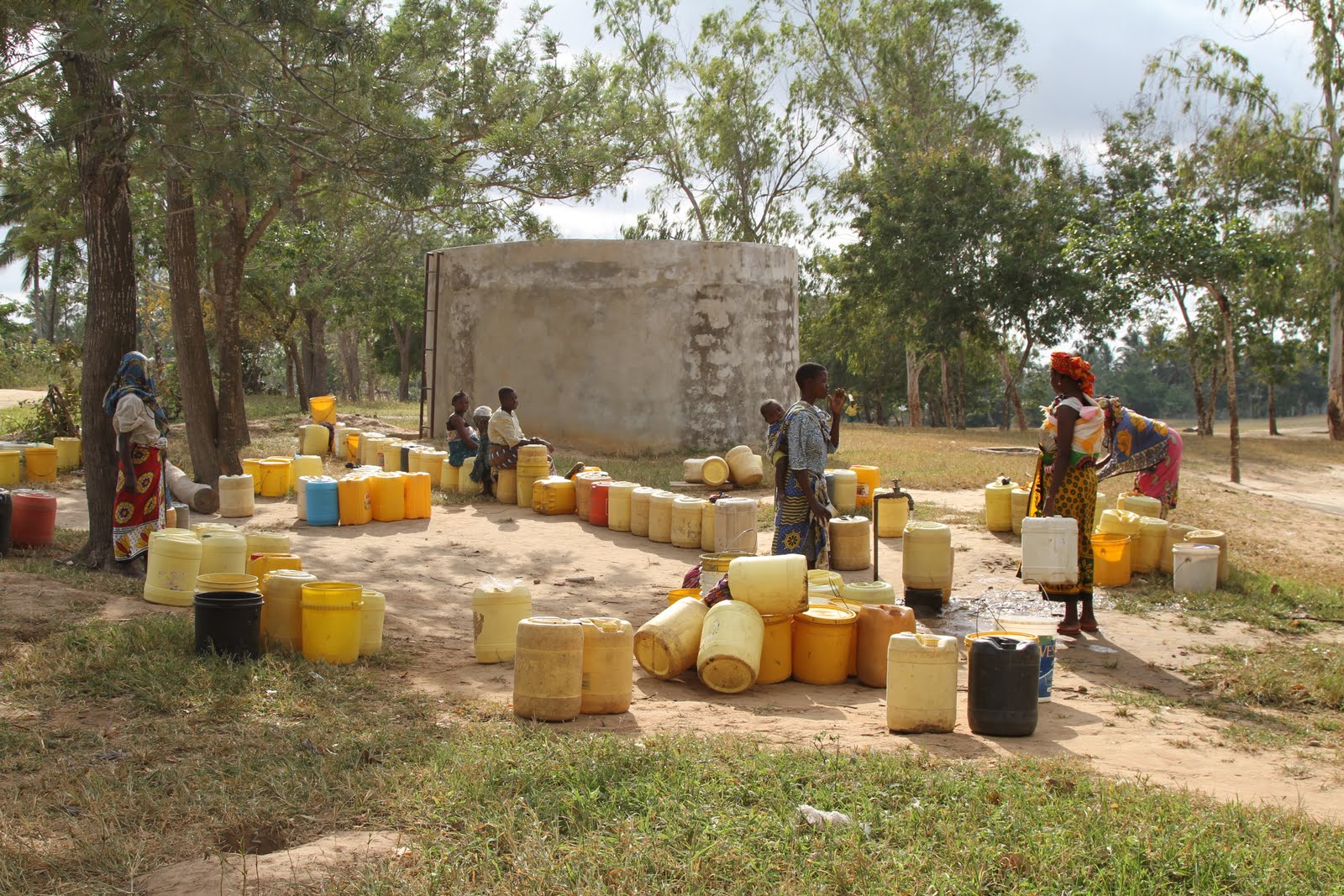
Women wait at water tap in Miyani to fill their buckets


On Sunday we go to church in Mombasa.  Afterwards we eat at a restaurant before going back to the village.  We are accompanied by a darling 19 year old girl named Leah.  I have the good fortune of sitting next to her and getting to know her.  After a while I am chatting with my fellow expeditioners about our lives back home.  We start talking about the many thefts in our neighborhoods, houses broken into, bikes and snowboards stolen out of our garages, etc.  Leah tells me she went to a secondary boarding school that was in a particularly dry area.  Each student, male and female, was responsible for getting his or her own water.  This meant they had to walk to get water every morning and evening.  The water was scarce and added manual labor to an already busy day of studying and learning.  Fellow students stole your water while you were in class.  This became such a problem that they built locked boxes for your water bucket.  Each day you locked your water in a box so other students wouldn’t be able to steal it.  OH MY!!!  We are complaining about stolen sports equipment and she tells us about stolen water!

Candace and Leah

One afternoon I am able to shadow a woman in the village named Betty.  She speaks excellent English so I am able to communicate with her and ask her many questions about her daily life.  She washes the tin pots, rinses her hands, cooks, does laundry, and drinks with the same water.  She teaches me to smash and grind the corn.  Betty and her daughter-in-law pick up every kernel that falls in the dirt and place it back in the bowl.  We make ugali (thick corn meal mush) for the children that stand outside her home.  We pick corn and vegetables in her shamba. 


Candace grinds corn 

Candace makes ugali

Betty and her daughter pound the corn


She tells me we are going to get water.  Previous experience tells me I can’t carry 5 gallons so I opt for a smaller container.  We walk 20 minutes with our empty containers.  We get to the watering hole and it has a locked gate.  She unrolls her kanga cloth, the one she will wear on her head to create a somewhat flat surface, sets it on the ground, sits down, pats the ground next to her and says, “sit down, we wait”.  “How long do you usually wait?” I ask.  “Don’t know, sometimes 10 minutes, sometimes 3 hours,” she responds. 
  
Waiting for the water hole gate to be unlocked

Locked gate in front of watering hole


As we wait women and children begin to stream into the area, all with empty water containers, waiting for water.  I count 70-75 people, all gathered around, chatting, children playing, everyone waiting.  It is a surreal moment, Kenyan women and children, and me, just me, waiting for water.  We wait 45 minutes until someone comes to open the gate.  We fill our containers, once again, everyone is watching me as I make an attempt to carry the water on my head.  I can hold it there for a short time, but still can’t balance, I opt to carry it as I have chosen 2 containers with handles.  As we are walking back to Betty’s house, a few English speakers yell out as they pass by, “carry it on your head”.  If I only could!  


Koins group visits the classrooms at Boyani

Another day we are told to get in the vans, we are going to a school that is further away, we won’t be teaching, we are just going there.  We do as we are told, pile into the vans, drive on more dusty bumpy roads to Boyani.  Young children are playing in the yard, some of them cry and run away when they see white people.  The teachers are thrilled to see us.  


A class is held under a tree, as there is no room available
I notice there is a chalkboard nailed to a tree with benches in front of it for use as a classroom.  We go into one of the classrooms made of sticks and packed mud, light streams in through the straw roof.   We talk to the teachers, play a bit with the children, take some pictures, and stare back at the children who are mesmerized by us.  I quickly notice there are no water containers in the classroom.  Since there is no water at most schools, the children bring their own water to school each day.  I have grown accustomed to seeing yellow water containers lined up in the back of the classroom or sitting next to the students.  Hmm, where is the water I wonder.  “How come the children don’t bring water containers to school?” I inquire.  “Because there is no water,” the teacher responds.  He tells us the closest watering hole has dried up as it is the dry season.  The next closest one has elephants drinking from it.  Last year a girl was killed by an elephant so the people are afraid to go there, yet some of them do.  The next closest is very far away, they walk 5-6 kilometers to get water in the rainy season and up to 10 K in the dry season.  I asked if any of the children at school had water or food to eat before they came to school, he said, “no”.  There is so little water and the elephants have trampled many of the cornfields.  The women may walk to water while their children are at school, that water will provide one meal in the evening.  He claims 500 children would be at that school if they had water, food, and classrooms, only 200 now attend.  When we leave the school we are silent in the vans.  Wow, no water, elephants at the watering hole, elephants trampling the corn fields, it is a lot to take in.  I struggle to wrap my brain around the lack of water here and the abundance of water at home.


Local women gather for a meeting with visitors from America

Word travels fast that a group of Americans are staying at the KCC.  A meeting is set up for the women of the local villages and everyone wants to be involved.  Women and children gather in the church next to the KCC.  Ingrid wants me to count how many are in attendance.  At one point I count 67 women and 75 children.  More women stream through the doors, most with a baby on her back and many with toddlers.  They all shift places on the benches and I lose track of the numbers. 

Candace at women's meeting


They are beautiful, so beautiful, black skin with dark eyes, broad noses, thick lips, most with short cropped hair, some with tight rows of braids, many with brightly colored scarves or cloths wrapped around their heads, shirts of varying types and colors, women wearing brightly colored kanga cloth skirts, some with flip flops, most with bare feet, all with dirty feet.  Babies tied to the back with a cloth are shifted to the front for convenient nursing. I live in the moment, I cherish this experience.  I love it here, I love these people.  I love every moment of teaching and serving the people of rural Kenya.  I notice no one carries water or a snack.  Many speak a little bit of English but most don’t speak any English.  


Naomi conducts women's meeting


Our interpreter, Naomi, interprets what Cindy has to say. Naomi is dressed in pants which is very unusual for this area.  She carries her baby on her hip in a more western way.  Cindy begins the meeting and welcomes the women with appreciation and love.  “What is your number one, first and foremost problem that you would like to discuss?” asks Cindy through our interpreter.  She restates the question by adding, “what is your biggest problem, how can we make your lives easier?” “Water, we need more water,” they state in unison. “We need more wells, we need more cisterns, we need ways to get more water.”  Water, the answer is water.  Water is their number one concern!  A lengthy discussion takes place about water and water rights.  Watching and listening to these women confirms my belief in the strength of women worldwide.  


Young mother and baby at women's meeting


We end the meeting and they ask us to sing and dance.  Ingrid, Cindy, Sarah, and I have to quickly come up with something that we all know to entertain them.  In an ironic twist we sing the primary song “Give Said the Little Stream”.  “Give said the little stream as it hurried down the hill”, we sing, we make up exaggerated actions for the song as we go along.  The meeting is over, I leave and go to the KCC next door and get a drink of water.

Our trip has ended.  We all make the long journey home.  Once in my own home I take a hot shower, warm water flows over my body.  I turn on the faucet, water flows freely, I brush my teeth, fill a large glass full of water and drink.  The next morning I am awakened by the sound of automatic sprinklers watering my lawn and flowers.  I get up, we eat breakfast together, I put the dishes in the dishwasher and turn it on.  Did you know a dishwasher uses 15 gallons of water each time you start it?  I put my clothes in the washing machine, my husband leaves to wash his car.  My friends are anxious to hear about my trip so we plan to meet at the local watering hole, commonly known as a swimming pool, a place where people play in thousands of gallons of water.  It has a splash pad next to it, water gushes up from the ground.  I watch as the children, friends, and families are frolicking in the water, screaming and squealing with delight. I am unable to speak, caught in the irony of the moment.  Tears are near the surface, to avoid them spilling onto my cheeks I ask my friends what has been happening with them while I was away.  One bought a new dishwasher, she said the heating element isn’t very strong so the water pools at the top of the glasses on the top rack.  Another friend has a new front loading washer and dryer, she complains that they couldn’t afford the pedestals to set them on so she has to lean over to take the clothes in and out of the machines.  A lifeguard blows his whistle at someone to quit running, the water makes the surface slippery.  Children go off the diving boards and down the slides into the pool of water.  We talk and laugh while we drink our flavored water.  When I get home a begin reading the book, A Long Walk to Water by Linda Sue Park.  I can’t focus on the book, my brain is scrambling, my brain is on overload, I can’t process such differing experiences.  I am completely immobilized.  I must find ways to raise money for the people in the Kinango District of Kenya.  I stare into space and think about water.  Water. Water is Life.  Water.
 ______________________________________________________


Through a donation from LDS Humanitarian, there are three borehole wells in the Koins service area.  Ultimately, we hope to have more of these kinds of wells available to the villagers, to provide fresh, clean water, at an accessible distance. 

Water is available to the villagers of the Koins service area from these sources: 

  • Above ground watering holes and rivers, subject to seasonal drought, disease, filth.  Also used by animals as their water source. 
  • Water cisterns.  Unavailable to the average rural Kenyan due to cost and the need for a tin roof and gutter to capture water.  Koins for Kenya builds cisterns alongside the schools we build, to capture rainwater and eliminate the need for children to bring water to school. 
  • Water taps.  The Kenyan government has provided water taps, such as the one Candace described on the outskirts of the Miyani school.   They are sparsely located, and the water does not always run.  They are subject to broken pipes and spigots.  When they work, they are a precious source of water to villagers. 
  • Bore hole wells.  These are costly, and need upkeep, but provide a clean, unlimited source of fresh water.  Currently limited to three wells in the Koins service area. 
  • An occasional water truck, sent by a humanitarian organization, will drive through more remote villages to deliver water.  Women will come running with their buckets to fill, eeking one more days worth of this life giving substance.  

Koins for Kenya is looking into a cheaper way to bore wells.  There is technology available that doesn't cost as much as a traditional machine drilled bore hole.  Using this new technology, it might be possible to provide a well for as little as $3,000 each.  We will be looking for sponsors to help us purchase the initial equipment. at a cost of $4,000 - $5,000, and provide the $3,000 wells in various villages.  It would be ideal to provide a well within reasonable walking distance of each village we serve.  Truly, water is life in Kenya. 

Asante sana, 

IVL 

Tuesday, July 26, 2011

Journey to Oz, aka Mnyenzeni (Sarah's Kenyan Experience)

This past July, I had the opportunity of being in the play, “The Wizard of Oz.”  In this American classic, a young girl named Dorothy is swept up into a tornado, and her house is dropped into a magical new land called Oz.  As she searches for a way back home; she finds new friends, who journey with her and together, they struggle to overcome great adversity and along the way, they each find out who they really are.  Little did I know as we took our final bows on closing night, that 3 days later, I was about to be dropped into my own magical land of Oz, destined to be changed for the rest of my life.  

My safari to the beautiful land of Kenya began as we drove on the bumpy road into the village.  I looked out the window at the beautiful landscape dotted with coconut trees, corn fields, and mud huts.  The people were coming out to the roadside, waving, smiling, and yelling “Jamboooooo!”  As I took in the breathtaking scene, a song came onto the radio and I heard the words, “Some people wait a lifetime for a moment like this.  I can’t believe it’s happening to me!”  It was like time stopped for a moment, and I knew that I was exactly where I was supposed to be.
Sarah and Fatuma

Sarah and Kenyan school children
I went to Africa hoping to serve, teach, and bless the lives of the people there.  I knew it would not be easy, and I was prepared to work hard and tough it out.  What I was not prepared for, was the immediate and immensely powerful LOVE that entered my heart the moment I stepped foot onto the African soil.  It literally encompassed me to the point that I was speechless, and motionless.  (Yes, I know it’s hard to imagine, but it’s true!)  Every time I found myself amongst the people, my heart felt like it would burst from all the genuine love pouring into it!  I think I spent the entire first day or two, just sitting and watching.  It was at that moment that I realized that I was the one who was going to be served and taught.  
Painting at the Tingey School at Gona

Sarah and Ann sweeping the floor of the Gona classroom

Over the next two weeks, I had the opportunity to teach in the schools, and understand the value of a good learning environment, and decent teaching materials.  I was taught  that what you learn, and know; not what you wear or own is where true value lies.  I got to spend the day with an African “housewife” doing her daily work with her, and learned that true strength doesn’t depend on how fast you run, bike or how many weights you can lift.  True strength is found in your spirit, as you smile and find joy in each day, no matter what your circumstances are.  I was able to find the child within as I  sang and danced with the kids, and found happiness and love in every moment. I learned the value of medicine as I  watched an African woman deliver a baby completely natural, with not a sound coming out of her mouth.  And as I worked in the dispensary, seeing lines of sick people day after day, knowing that there wasn’t always medicine available.  I realized that my own child would probably not be here on this earth without the life saving medicines I am able to give her each time she needs it.  I learned the value of water, every time I looked outside and saw the people who always had the yellow containers of water with them, and knowing that they have walked miles, a few times a day to get that precious dirty water.  I learned the value of beauty and cleanliness as we painted a new school, and swept out the dirt with some brush gathered nearby.  I was taught the importance of acceptance and tolerance as the Duruma tribe took me into their arms and accepted me as one of their own, unconditionally, even giving me a new Duruma name to show that I was one of them.  I learned to appreciate the grocery store as I cut the head off a chicken, plucked and gutted it and cooked it for dinner.  I grew to appreciate moderation as I showered under the African sky each night with only a bucket of water, and learned how little water it really does take to clean myself each day.  I came to understand the importance of poli, poli, or slowly, slowly as I took walks through the corn fields, and along the paths.  And realizing that slowing down and taking the time to talk and develop relationships with those I love is where peace is found.  I found humility as I thought I would teach a small boy to play marbles, only to discover that he had the shot of a western gunman!  I learned the importance of “holding tightly”, as I rode on the back of a dirt bike over the bumpy dirt paths.  


Slaughtering chickens for dinner

Home building the Kenyan way

These were my favorite moments; these little snapshots in time when the world would stop, and I would feel that my heart would burst as I connected with the spirits of these beautiful and strong people.  The little “chocolate” messages that said, “you are exactly where you are supposed to be,” getting to know the amazing American people who were serving with me, and realizing that they will always be in my heart as well,  this is what left me with tears in my eyes, day after day.
Carrying water like a Kenyan woman

Sarah and Monica with primary school teacher

We learned to do laundry with buckets and little water
(Nice) Kenyan showers
As we all traveled together, black and white, male and female, young and old, overcoming adversity, connecting and serving each other, I believe we all found out a little more about ourselves.  We discovered that we really do have the courage, heart, and brains to make it through this life... as long as we do it together.  I learned, just like Dorothy, that even though I love the people and land so much, and that they have helped me find myself, there is a land and people that I love even more.  And I don’t need to look any farther than my own backyard to find it.  The truth is, it is wherever we all go, because it is in our hearts.


As I walked through the airport before my final leg home, I was led to a little bracelet charm that now hangs on my wrist.  It has two ruby slippers and says, “There is no place like home.”  It was the final message to me and I will never forget it.  The song “for good” from the musical Wicked, (the prequel to the Wizard of Oz) sums it up best...
“You’ll be with me like a handprint on my heart, and because I knew you, I have been changed for good.”


Monday, July 25, 2011

Karen's Village Shadowing Experience, July 2011

Each expedition, we offer an opportunity for women from our group to shadow a Kenyan village woman, allowing a real taste of Kenyan life.  Karen Timothy and her daughter Tara, shadowed Frida for an afternoon, working alongside her as she did her daily work.  This is Karen's experience:

Tara, Frida and her family
A Day in the Life
            A friend once told me, “If you want to make God laugh, tell him what you have planned for the rest of your life!”  Truer words were never spoken as I found myself trudging slowly along the rutted path to a home in the village of Vikolani - somewhere in Kenya, Africa.  My daughter, Tara, and I were dressed in classic D.I. attire with the bright, colorful African kangas all women in the villages wear tied around our waists.  The beautiful African woman leading us to her home we knew only as “Frida.” 

Karen and Tara in front of new Tingey School in Gona, Kenya
            In a spur of the moment decision back in the states, Tara and I had decided to accompany my sister and brother-in-law, Sue and Curt Tingey, to Kenya to turn over a school they had built through the Koins for Kenya organization in a place known as Gona.  We joined the July 2011 expedition and the rest is now history…but a piece of history that will accompany us throughout the remainder of our lives.  Having just returned and not yet got our sleep schedule back to normal, I find myself “up in the night” and of a mind to make good on a commitment to do a blog entry about our trip.  Of the hundreds of things I could write about, I have chosen to share an experience known to Koins expeditioners as “shadowing.”

            Through some spark of inspiration that I don’t actually know the origin of, the leaders of Koins have set up a program where expeditioners can spend a day – or part of one – with a local woman, family or student and go about their daily walk with them.  We do whatever they are doing in their normal course of living and in the process, are humbled and amazed by the strength, determination, and courage of a people whose lives are so different from our own.

            Frida walked to the KCC to pick us up one afternoon so that we could go to her home and learn about the life of a woman living in a village in Kenya.  She had made the walk earlier that day only to find out that we were scheduled to be teaching at a school in the morning and she would need to come back for us later that day.  With a shrug of her shoulders she turned and walked the long path back to her home without the visitors her 5 waiting children had expected her to bring back.  Two maddening things here:  1) Communication is quite difficult in the village.  You think you have explained your intentions but the facts are often “lost in translation” even though most of them speak English – with a heavy British accent. Somehow Frida thought we were coming to her house in the morning, so that bit of miscommunication cost her an extra hour of walking since that is her only mode of transportation; and 2) There are no addresses or logical streets that would have allowed us to find her house on our own which necessitated her return trip that afternoon.  They have all lived their lives there and know where everyone lives so they have no need of such things as addresses. 
Frida prepared chai tea and cookies before the work began
            Walking to Frida’s house turned out to be about as fast as driving would have been.  The road is so rutted, with giant crevices on every side, that the vans we had taken to the Vikolani school were no more swift than our unhurried stride.  We were greeted at her home by 4 happy children and 1 non-plussed baby.  The home was made of mud packed onto a stick frame with a tin roof.  They obviously did not know the story of  “The Three Little Pigs.”  Once inside we were invited to sit on a grass mat that Frida rolled out onto their dirt floor.  She introduced us to her children Patrick, Beatrice, Patience, John, and Eunice as their chickens strutted in and out of the room.  After strapping Eunice to her back with a kanga (pronounced “conga”), we were told that we would first go out to her kitchen to make tea before we began our work.  The kitchen was a separate mud hut with a thatched roof where she cooked over a fire with more chickens looking on.  We explained that while we don’t drink tea, we would love to see how she makes it.  This seemed to suit her and she proceeded to have Tara help start the fire and pour the tea leaves into the boiling water that was later flavored with sugar and some sort of milk from a box.  The water looked clear enough so we assumed it came from the cistern outside the door.  The cistern is a round cement holding tank that collects water from the roof of the house through rain gutters and a long pipe connecting the house to the cistern.  While this water is vastly cleaner than the water we would soon collect from a watering hole, it would give those of us not raised on it a bad case of dysentery if we were to drink it straight from the cistern.  Once the tea was made we went again into the house for tea and cookies.  It was hard to eat their cookies knowing how little food they had and how much of an extravagance this must have been.
Karen pounding corn

Frida and Beatrice take over pounding the corn
            With these amenities over it was time to go to work.  We were told we would first pound corn.  Tara and I donned our brand new leather work gloves and went out to find 2 huge poles and a wooden “thing,” for lack of a better word, that they poured corn and water into.  We would then alternately hit the corn with our poles to try to coax the hulls off, separating the corn from the chaff.  They humored us for awhile, then Frida and Beatrice took over and got the job done.  That little 10-year old girl had obviously spent many hours at this job, as had her 7-year old sister.  When I asked 13-year old Patrick if he was good at this, he said boys don’t do that kind of work.  Hmmm.
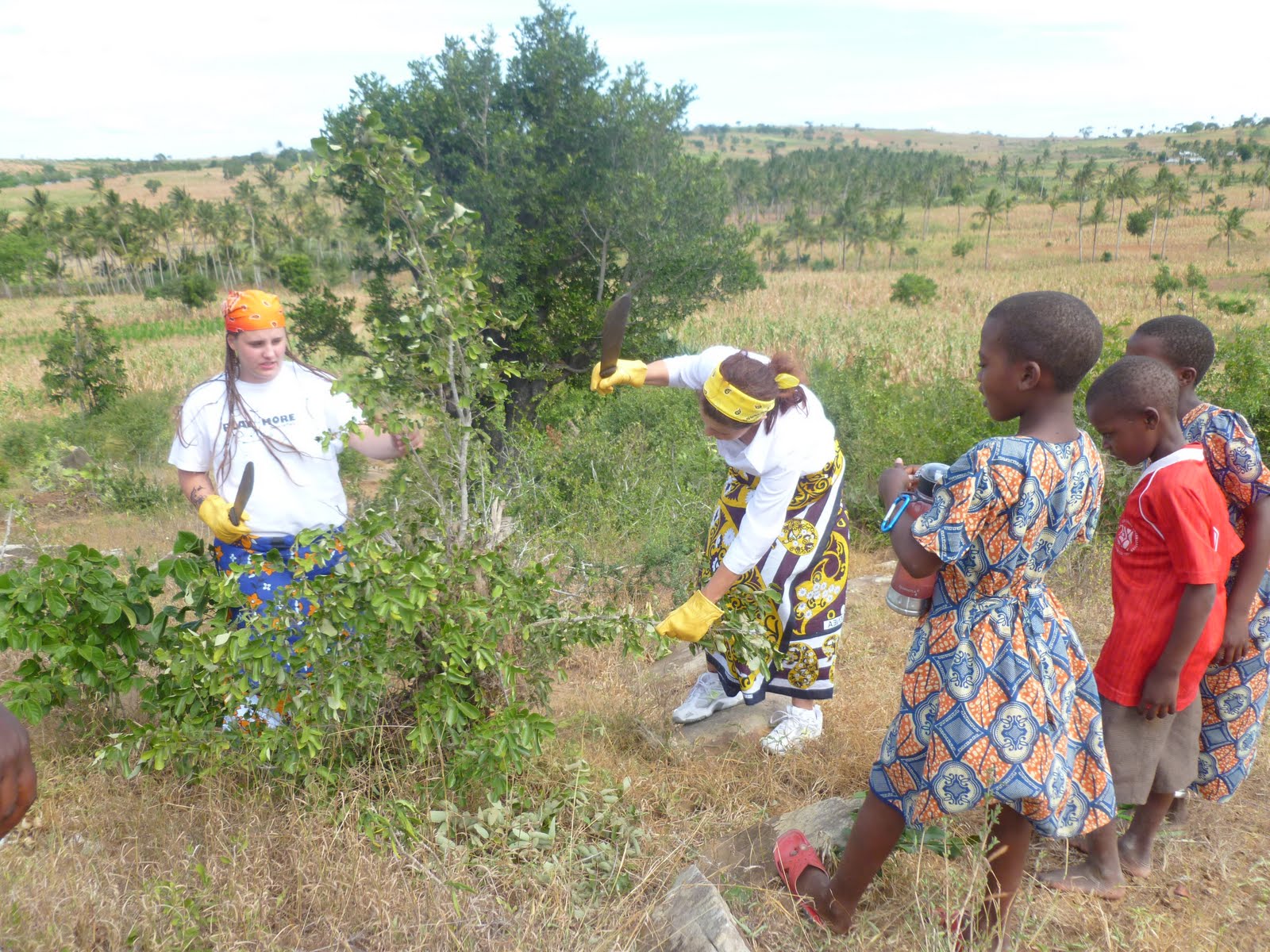
Karen and Tara chopping branches for firewood

Tara wields a machete well

Karen arranges branches for bundling

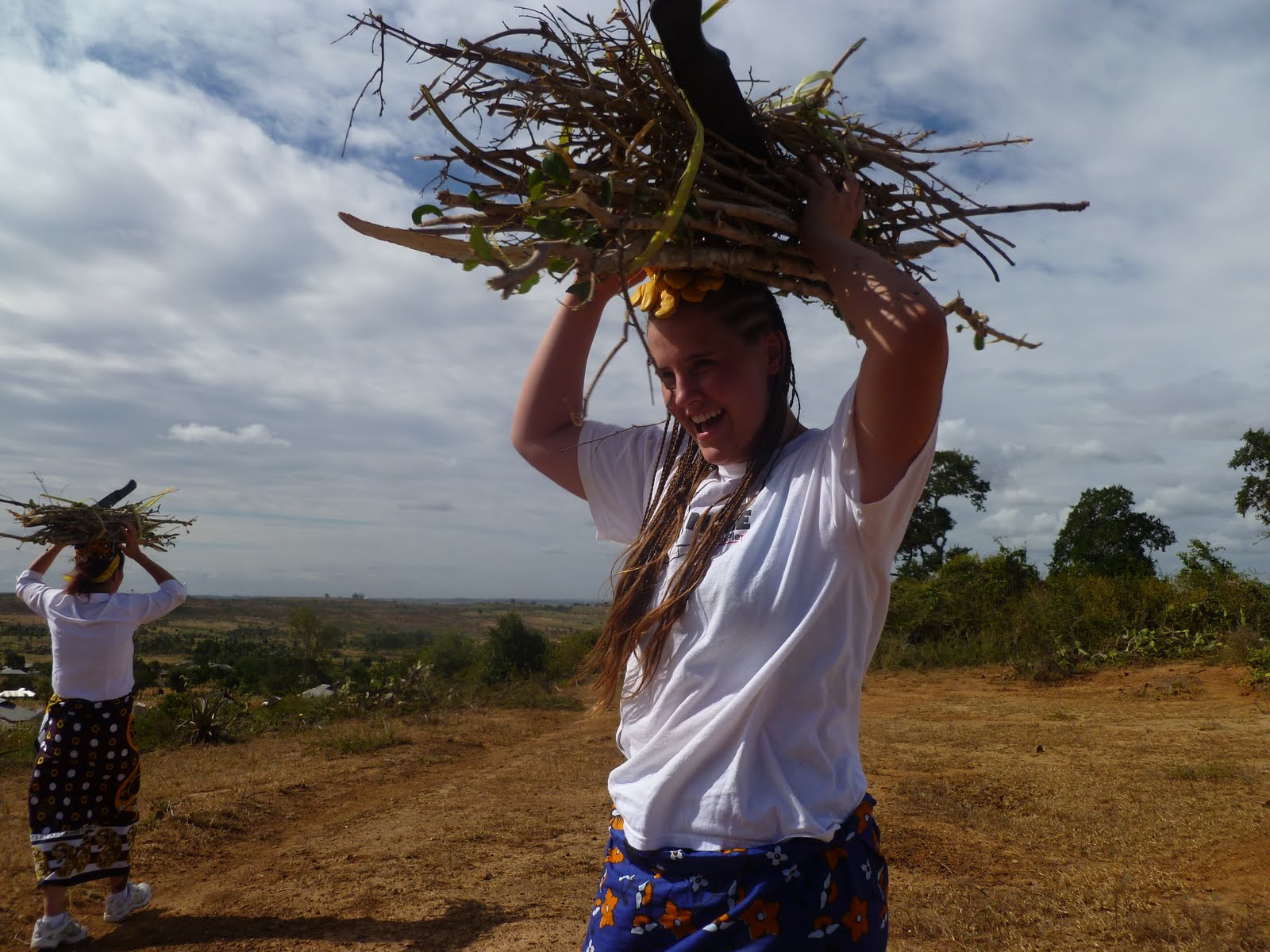
Preparing to carry branches back to Frida's house

            Next it was time to chop firewood.  Beatrice took us over and plucked each of us a nice long sisal leaf.  I turned to Frida waving my leaf and told her this chopping job was going to take the rest of the day if we had to do it with a sisal leaf!  She burst into laughter and became my sister as I found that her difficult life had not robbed her of her sense of humor.  Actually, the machete we were given to do the chopping was so dull that a sisal leaf would have worked just as well for me.  While Tara did OK, I couldn’t hit the branch in the same place twice and Beatrice had to, again, finish my work.  This was also not work Patrick had ever done so he just kept taking pictures.  Once the branches were cut from the green bushes, the smaller twigs and leave had to be chopped off.  Couldn’t do that either!  You had to hit it a certain way and I was just annoying the branch with my useless hacking.  Tara got her branches clean.  Show off.  Next we put those sisal leaves to work.  Beatrice peeled them length-wise and tied pieces together making a very strong and efficient rope.  We laid the sisal on the ground and stacked the branches on them.  I was good at this!  We then tied the bundle of sticks together and popped them on top of our heads!  In order to get water before the sun went down we had to hold the bundle in place as we walked back to their home.  Real African women don’t touch the sticks.  You’ve never seen such balance.
Tara gathering water

Karen takes a turn

Buckets full, ready to return to Frida's home
            Next we had to go get water.  We got several filthy plastic jugs and headed to the stream.  It must have been ¾ of a mile away because it took awhile for us to get there.  Once there, we were given a smaller plastic jug that had been cut in half and pierced with a long pole.  We dipped the jug in the water and pour it into the larger containers.  For many, this filthy water was drinking water but because she had a cistern, Frida was using it for cleaning purposes.  She said she comes for water about 3 times a day.  At the health department back home we were told not to touch this water since there was a parasite in it that could enter through our skin in about 15 minutes.  We were careful not to fall in.  I felt bad that we had to dump out about half of the water out of my 3-gallon jug in order for me to carry it back home on my head.  I’m sure that made for an extra trip.  After 15 minutes my neck and back were burning but I kept telling Frida I was fine each time she asked if I was ready for her to carry it.  Somehow, having her carry the water on her head while carrying her 2-year old on her back just didn’t seem right.  I know she does that every day but not on my watch.  Several of the village women congregated to watch us “do Fridas work” so I proudly walked several steps with my arms outstretched so they could see that I could carry it without holding it if I really wanted to!  I wanted to for about 5 seconds.  Again, Patrick manned the camera since men don’t fetch water.  Aarghh!

            Back at home we rested for awhile.  Frida kept saying how tired she was and it concerned me but at our protest, she walked us back to the Koins center after we had said our good-byes and taken a few more pictures.  A few days later, Patrick came to spend the day at the KCC.  We sat visiting with him for awhile and since our conversation topics were limited I mindlessly asked, “What’s your mom doing today?”  Cindy looked up at me and smiled and I knew both of us were thinking the same thing…..” beating corn, chopping wood, fetching water.”  That is their day.  With not a chair to sit on or any help from the men or boys, African women grind out their lives in difficult tasks under dire circumstances.  I can only imagine what it is like at 100+ degrees. 

Tara and Patrick, Frida's oldest son
            I am still trying to process it all as I sit in my comfortable home able to drink water from a tap and take clean, fresh food out of a refrigerator.  It seems like our trip to Africa was another time rather than another place.  On the way to the airport Bret told us that 10% of the babies and 7% of the mothers die in childbirth because most of them have their babies in their huts.  Sue and I had taken 2 armfuls of tiny fleece blankets made by her friend, Crystal, to the dispensary earlier that week and each new mother was given one to take home.  Bret said that these blankets are literally saving their lives because they will now come to the dispensary to have their babies in order to receive one of these blankets….a possession.  One morning at 4 a.m. Tara was sitting on the porch of the KCC unable to sleep.  As she did so, a man came barreling down the path towards the dispensary pushing his pregnant wife in a wheelbarrow as fast as he could hoping for her to deliver the baby there.  She did and was given a soft little blanket to wrap her child in.  Lucky woman.
           
A mother and brand new baby receiving a blanket at the dispensary
Karen has done a great job of summarizing her shadowing experience.  I hope to be able to share many other experiences from the recently returned expedition.  Life in Kenya is very different from our own.

Asante sana!

IVL

Sunday, July 3, 2011

Women's Forum Meeting, August, 2010

As I was reviewing my notes from last year's expedition, I realized I had never posted the notes I took during our women's forum meeting held at the KCC.  We invited women from Mnyenzeni to join us for tea, cookies and an opportunity to talk openly about our different lives.


Wednesday, August 4

Women's meeting at KCC

All women came with babies.  12 village women, 13 Americans: 
Robyn Kimball - Utah
Umazi Dzombo - Mnyenzeni
Mjeni Dongoi - Mwache
Kendy Taylor - California
Uchi Chondo - Mnyenzeni
Zawadi Ndawa - Mnyenzeni
Asha Dzombo - Mnyenzeni
Marcie- Utah
Lacee- Utah
Sherrie- Utah
Mbeyu Chombo - Mnyenzeni
Fatuma Chondo - Mnyenzeni
Leigh - Utah
Cindy- Utah
Shelley- Utah
Sara Chikuta - Mnyenzeni
McCall- Utah
Kanga Juma - Mnyenzeni
Mjeni Viyani - Vikolani
Kris - Mwaka- Utah
Zilpa Mlongo - Mwongaraba
Ingrid (KweKwe) Utah
Margaret Luvuno - Mnyenzeni
Naomi Mwenda - Mnyenzeni
Jami (Chizi)- Utah
Lindsay (Pola)- Utah

Open time for questions:

There was a vote held during our stay, the citizens got to vote on the constitution.  
Kris: Who voted?  7 women voted.

Constitution interpretation:

New constitution is better.  President has to win by certain percentage.
People vote and win is decided immediately, not months later. 

Naomi:  Most people are squatters, at any time they could be told to move out.  
Land in Duruma land is clan owned. 

Margaret: She has decided to vote for constitution for next generation.  Has brought men and women together in vote.  Equal rights approaching.  Kind of a 70-30 equation.  Encourages women's education.  This constitution will give women more rights, especially in area of inheritance.  Women will be counted in division of parents assets, not just men now.  No child labor.  Children to be in school not working through Grade 8.  6,000 ksh per year for scholarship, only for school lunch cost.  10,270 ksh from government for school fees. 

It appears the constitution will pass.

Men also supportive of this vote.

What is issue they are concerned with most?   
Delivering babies.  Most give birth at home with help of a midwife (often mother-in-law).  Average # of children for Duruma:  8-9  

Reasons for large family: naming children after someone important to them. Lack of family planning is tradition.  They need to birth more than 10 children to be called an "African woman".  High mortality rate.  Out of 100 children, 20 die before 5.  If they don't continue pregnancies, they worry husband will leave.  Hesitant to do family planning, for fear of husband's reaction  2 of the group have 10 or more children.  One of them was 15 when she had her first child.

Most standard 8 dropouts get married and pregnant young.  Question: what would happen if girls get pregnant without being married: Traditionally chased to grandma or aunt and will not come back.  OR your parents will ask you to tell who is the father of the child and you will be forced to marry him.  If you marry someone else the child remains with aunt or grandma. 

How many have had a child die? 8 of the 12.  Margaret has had 3 children die, 3 months, pneumonia.  Malaria, 6 months.  Malaria, 15 months. 

Question from Margaret: What does our constitution do for women.  In Kenya it is possible for a woman to run for president.  But women don't generally support women politicians there. 

Husbands can beat wives, wives can seek legal action but it is a long tedious process.

Question:  Is family planning practiced in states? What is size of average family?  surprised by the answer of 2-3.  Surprised by Jami having 8 children, having many children ages mothers here, so they look much older than we do.  Margaret is about 40.

When they have twins did they know they were having them? One did, one did not.

Often people go away and live together without marriage.

No dowry paid for wife in U.S.  Bret explained specifics of relationship in America.  Now that girls are becoming educated, their daughters will begin to move the way of Americans.  By letting them get educated, they will improve their lives. 

After they have a baby, how long do they rest.  40 days of rest.  A family member will come to help them with work.

Is husband there when your children are born? In hospital, they are able to be there.  At home, no.

Can a man have two wives in America?  No, he will get sent to jail.  Laughter.

Bret:  In U.S. he will cook in his kitchen.  Help clean the house.  If he has his friends at the house, he will cook and serve them.  In Kenya the husband will order the wife out until the baby is quiet. 

When a husband has more than one wife, the wives do not get along and usually don't live near each other.  Men sneak out to see other women.  Women always have responsibility of the home and family. 

Most difficult work they do?  Fetching firewood.  Fetching water.  Working in fields.

If something needs to be purchased, where do they get money to buy?  If husband is working, he can give money for a purchase.  If husband has no work, women must do odd jobs to raise funds. 

Raise hand if husband works with a salary.  2 raised hand.  1 works at dispensary.  1 works as a cook at a boarding school.  One lady has a husband who was employed but he died from a boil (abscess).  The remainder of them will raise corn in their shambas to survive.
   
As you can see from my notes, I was typing as a conversation was going on.  It was an interesting conversation.  Bret coming into the room helped the conversation get going.  The village women in Kenya tend to be very quiet and submissive.  They aren't quick to offer information, unless they know or trust you.  They know Bret because he has been coming to Mnyenzeni for so may years.  They offered more information once he encouraged them to talk to us.  

During the 2 hours we met, the women enjoyed chai tea and the flat biscuit type cookies common here.  They were quick to feed their babies both the tea and cookies as well.  

The American women enjoyed the information we gleaned from the village women, and learned more about their lives.  This kind of interaction helps us to understand their lives better.  We as Americans have such easy lives by comparison.  

An interesting afternoon. 

Asante sana, 

IVL

Saturday, July 2, 2011

Top of Utah groups, schools donate to Koins for Kenya - Standard-Examiner

Top of Utah groups, schools donate to Koins for Kenya - Standard-Examiner
see photos and read story by clicking on link above

By Ruth Malan

Standard-Examiner

Stndard-Examiner correspondent

Fri, 07/01/2011

FRUIT HEIGHTS -- Many young students in Kenya no longer have to sit on the dirt floors of crumbling schools built of sticks and mud.

That's due to the help of a few Top of Utah locals, including Morgan resident Cindy Workman and Fruit Heights couple Sue and Curt Tingey, who all became involved in a project called Koins for Kenya, a foundation that provides ways for caring Americans to actively engage with rural Kenyans to provide education opportunities.

Ten years ago, Bret Van Leeuwen, of Alpine, went to Kenya and found such a great need for outside help that he formed the foundation Koins for Kenya.

Workman, a Morgan resident and sixth-grade teacher, also helped form the foundation.
"Ten years ago, I went to Africa with another humanitarian project," Cindy said. "I met Bret and we wanted to do something for the same village and it grew from there."

Sue Tingey heard of the needs in Kenya and also desired to help. Because of some health problems she didn't have the opportunity to go with her husband when he first took the journey to help build desks for the students. But last year Sue went along, and she will be leaving July 8 on another expedition.
"At first I thought the problems were so enormous that I wondered if we could make a difference. They need water, housing, sanitation," Sue Tingey said. "Last year when we went, we added another room to a school."

Anyone can donate coins for Kenya, but several local schools have already helped in a big way. Windridge Elementary, of Kaysville, where Workman teaches, has already helped to build a school. This year, Windridge and Eagle Bay Elementary, of Farmington, collected a combined total of $10,000. Also, Guy Child Elementary School, in South Ogden, collected enough money to pay to build a cistern to collect rain water.

Each spring, Workman's class has a water walk so they can understand what it would be like not to have water in the house.
"The thing that's most awesome is to see 12-year-olds involved," said Workman.

Students in Kenyan villages must get their own drinking water.
"They usually get their water from a watering hole where animals also go," Sue Tingey said. "When the children are on their way to school they stop to get water to drink for the day."

Villagers are getting a hand up, not a hand-out.
"Villagers must put up 10 percent. They must sacrifice, cash is a really big deal," Sue Tingey said.
This year, the group traveling from Utah to the village of Mnyenzeni will build a school, two cisterns, a latrine and school desks, she said.

Curt Tingey oversees the wood shop, where desks will be built for the 300 children who will attend the three-room school. He is also building tables and furniture for the teachers, who currently must stand all day as they teach. Because they have no school supplies, Koins for Kenya will take science supplies to them.

Workman's classroom also raised money to purchase a microscope for a medical clinic. Both Workman and Tingey explained that the Kenyan government will not provide treatment for those with malaria unless they are first tested. The clinic had to have a microscope in order to provide the test. The microscope was delivered in January.

"The next day, eight people were tested and six had malaria. You could say we saved six peoples' lives," Workman said.

Sue Tingey's sister, Karen Timothy, of Fruit Heights, also wanted to get involved in Koins for Kenya.
On June 28, more than 160 people gathered in the backyard of Timothy's home for a fundraising dinner. It was a familiar scene, as this was the 12th dinner Timothy has hosted.
"To do service is a great experience. It's been so much fun," Timothy said.

In May, Tingey arranged for a huge garage sale, with items donated by friends and neighbors that raised over $5,000.

None of the money goes to overhead, it all goes to help the people, she said.

It is a tradition in Africa that schools be named for those who provide the school. However, Tingey said she was uncomfortable with having a school named for her family.
"It is an honor for them to meet you. This isn't something I am comfortable with, but I have to look at their point of view," Tingey said.
The school they will build this summer will be named "The Tingey School of Gona."
"We are naming it in honor of our kids," she said.

Donations may be made to help with the many projects taking place at Koins for Kenya. For more information go to www.koinsforkenya.com
 
According to their website, "The goal of Koins for Kenya is to develop programs which are self-sustaining."

Monday, June 13, 2011

Language Translator added to Koins Blog

I just added a widget to the right side of the Koins blog, so if you are reading this in a foreign country, you can now translate the body of the text to your native language. 

Look for the Google Website Translator Gadget on the right side, and choose your language from the drop box. 

We have had readers from many countries around the world, this should make it easier for you to read about the work we are doing in Kenya.

Asante Sana!

IVL

Friday, June 3, 2011

Cindy Workman, Teacher Extraordinaire

Class meeting under tree, because of classroom shortage in Kenya
Bret asked that I tell the story of Cindy Workman and Koins.  She has been an important part of the Koins story from the very beginning, when she and Bret met on an expedition to Kenya in 2002, and their individual passions for helping rural Kenyans meshed and the idea for Koins for Kenya was ignited.

Here is Cindy's story:


Cindy Workman, a teacher at Windridge Elementary in Kaysville, Utah, placed a robust jar atop her desk.  She magically described her recent experience in Kenya to her young students, expressively illustrating what wild animals she had seen, and the beauty of the landscape in Kenya.  In her animated way, Cindy talked about the new friends she had made in the local village, and how she had helped carry a large bucket from the watering hole to the mud hut where her friends lived.  As her captivated students listened intently, Cindy then spoke of her long trek up a hill to where a school was supposedly located.  The villagers wanted this American teacher to see their children learning, so she hiked with them up the steep rise, through rocks and thorns, to the village of Chikomani.

Stretching her arms as wide as they could go Cindy described the gigantic size of the baobab tree at the top of the hill.  She told the children that it was often called the “Upside Down” tree since it often looked like the roots were in the air on these giant trees.  Then, as she tried unsuccessfully to choke back her tears, Cindy described what she saw as they drew closer to the tree.  There were forty-five to fifty small children encircling the tree.  An adult stood at the massive trunk holding a broken piece of plywood that had been covered with a thick coat of blackboard paint.  The wind blew constantly, requiring the teacher to keep hold of this makeshift blackboard that thrashed about as she explained the lesson to the small children in front of her.  The large tree provided shade during the heat of the day, or shelter from the rain, but it was a difficult environment to learn.  Cindy was moved at the sight of these small children and what they would endure to gain an education.  Now, standing in front of her own classroom thousands of miles away, she fought back her emotions as she recounted her experience to her stunned students. 

The jar she placed on her desk was to collect the pocket change of her young students throughout the year.  On many occasions Cindy was asked to tell her story again and again.  The vivid recollection of her long walk to Chikomani, the giant tree, and the group of students assemble underneath its massive branches never dimmed.  Day by day the jar collected shiny nickels, and an assortment of other coins.  A few dollars were donated and the jar filled.  Cindy placed a sign on the jar delineating the purpose for which the funds would somehow be used – Koins for Kenya.

At the end of the school year an accounting took place.  The money that had been raised by these diligent humanitarians was donated to the new foundation that had taken Cindy to Kenya.  When the last penny was tallied Miss Cindy’s class had raised enough funds to construct a small classroom building on that hill in Chikomani.  The children of that village have enjoyed a comfortable environment over the past couple of years due to the assistance of the class so many miles away.  Both schools share the same name – Windridge – and although they are separated by vast lands and deep oceans, they share the common strings of education, a windy knoll, and Cindy Workman, the teacher responsible for educating eager minds on two continents, and providing the inspiration for the naming of the Koins for Kenya Foundation.
The Workman's with students in new uniforms under the baobab tree that used to be their classroom
P.S. – Cindy Workman has continued her efforts with the same simple jar sitting on her desk.  Her stories have grown through her many visits to Kenya, as have her fundraising efforts within her school area in the states.  With her coordinated efforts she and her students have constructed additional classrooms, much needed water cisterns, and latrines for her kids in Kenya.  Mama Cindy, as she is known in this village area, is the symbol of the humantarian spirit and endless love for children.  With dirty little faces, and tattered clothes, these village children greet Mama Cindy with a resounding song when she visits.  Parents praise her for her efforts as they recognize how she impacts their children’s lives.  As Mama Cindy hikes the hill to Chikomani, villagers greet her by name, occasionally introducing her to their newborn babies, many who now bare her name.  They will attend the Windridge School that is shaded by the baobab tree.  The Kenyan Government has recently recognized the Windridge School at Chikomani, providing certified teachers for the classrooms.


Through Cindy's passion and love for teaching, she not only brings education to a rural village in Kenya, but she enriches her 6th grade students and starts them on a course of humanitarianism that will stay with them throughout their lives.  

Cindy has made the trip to Kenya several times, and will again visit Kenya this summer, bringing more blessings to the village of Chikomani.  

Cindy and her husband, Mike, are board members for Koins for Kenya.  It is individuals such as the Workman's whose vision and hard work keep hope alive in Kenya.  

Asante sana! 

IVL