Because of an obsession with all things African, I have decided to go to Kenya for two weeks with a humanitarian group, “Koins for Kenya”. I read every word of their website, every blog, and look at every picture. I plan and prepare, I collect items to take with me for the school children. I am excited for this amazing journey.
 |
| Kenyan women returning from water hole |
I am absolutely intrigued and fascinated by the fact that women carry 50 lbs. of water on their heads in 5 gallon buckets, with bare feet, and often a baby tied on their back. There is no way, it can’t be possible. I study the pictures and look at the artists drawing on the outside of the Koins Community Center (KCC). I am amazed, in awe, I can’t wait to see the strength of these women, I want to try it myself, I want to experience everything.
 |
| Madie, Jessie and Candace with Kenyan children, dry river bed behind them |
 |
| Young mother collecting water for her family |
 |
| Women and girls gather at water hole to fetch water |
We finally arrive in Mnyenzeni after many long hours of traveling. We take our belongings into the KCC, our two week home, receive an orientation, and find our bed. Bret informs us that we will be going on a walk in 30 minutes. He takes us on a tour of the village. Our last stop is the local watering hole, however, we don’t know that yet. You can’t see the water, it is surrounded by tree branches piled up to make a fence. Bret doesn’t tell us this is where the water is, he points out the fence, explains it keeps the animals out, “in a moment you will see why,” he tells us. We round the corner and there it is, my heart leaps, this is where the villagers get water. There are many women and children in bright colored kanga clothes collecting and carrying water. The water is a mucky dirty brown. They are dipping a milk carton type of thing with the top half cut off and a stick attached into the water and filling up yellow containers of varying sizes. Bret asks, “who wants to try?” I immediately volunteer, I don’t know my group very well, they must all think I am crazy to quickly try such a thing, and in front of all these local people. Bret tells the group there is no way any of us will be able to do this task. I take it as a challenge. He summons a teenage girl to help me, she shows me how to dip the dipper in and fill up my bucket. I take off my shoes, wade into the sticky mud and start to fill my water jug. I immediately spill the water, I am leaning over, scooping up water and filling a bucket. It is slow and laborious. I quickly notice that all the local people are watching me and I am making a mess, spilling water onto the dirt. Finally my water bucket is full, the girl places a rolled up cloth on my head to make a somewhat flat surface, it takes two girls to lift the water bucket and place it on my head. It is heavy, so heavy, my neck aches before I even start to walk. I try to balance for a half of a second but I can’t do it, my arms fling up to support the edges of the bucket. Water spills out of the bucket and down the front of me. The locals are staring and laughing, it is nice of me to provide some evening entertainment for them! Don’t they understand? I have been turning on faucets my whole life, NOT carrying water on my head!! I walk a few feet with the bucket on my head, not balanced but held on the sides by me, it is heavier by the second. There is a small dip in the dirt and I can’t make my way down the simple incline with this heavy bucket on my head, two young girls take the bucket off. The teenager that helped me hoists it on her head and walks away. I have experienced the water carrying and failed miserably. I watch the women and children in continued awe and amazement. A young girl of 8-10 years old can fill, balance, and carry more than I am able. We stay and watch for a while. Shelly and I are the last to leave. As we leave the watering hole I see a beautiful sight, one I will never tire of, a stream of females of all ages, walking down a dirt path, many in brightly colored kanga clothes, all with yellow buckets of varying sizes on their heads, most have bare feet, many have babies tied to their back. I have finally seen this amazing sight, I have finally experienced it. Life is so different here. We are in Mnyenzeni, Kenya.
 |
| A young Kenyan girl brings water back to her home |
Water. Water is life. I pay attention to water, I think about water, I notice the absence of water for the rest of our trip. The fields of corn and vegetables are so dry. There is obviously no irrigation, no automatic sprinklers, they rely solely on rainfall to water the fields. Bret shows us a cistern and explains how it works, it collects water from the tin roof of a building when it rains, however, it dries up when there is not enough rain. We have water at the KCC, taps that turn on, toilets that flush, clear blue jugs full of purchased fresh drinking water for sensitive stomached Americans. We are an oasis in the desert, the villages around us do not have running water. I am still fascinated and intrigued by women collecting and carrying water. I sneak away from the KCC most mornings and early evenings, sometimes by myself, sometimes I summon a friend to go with me. I walk the short distance to the watering hole. I sit or stand and watch, observe the strength of these females of all ages collecting water and carrying it on their heads. Sometimes I go in and stand by the water, sometimes I watch from the outside as the trail of women with yellow buckets on their heads walk to their homes. I never get tired of watching, I want to imprint this on my brain forever. I will not see this in my neighborhood, I have not seen this in my many travels thus far.
 |
| Women and girls going to and from water hole |
 |
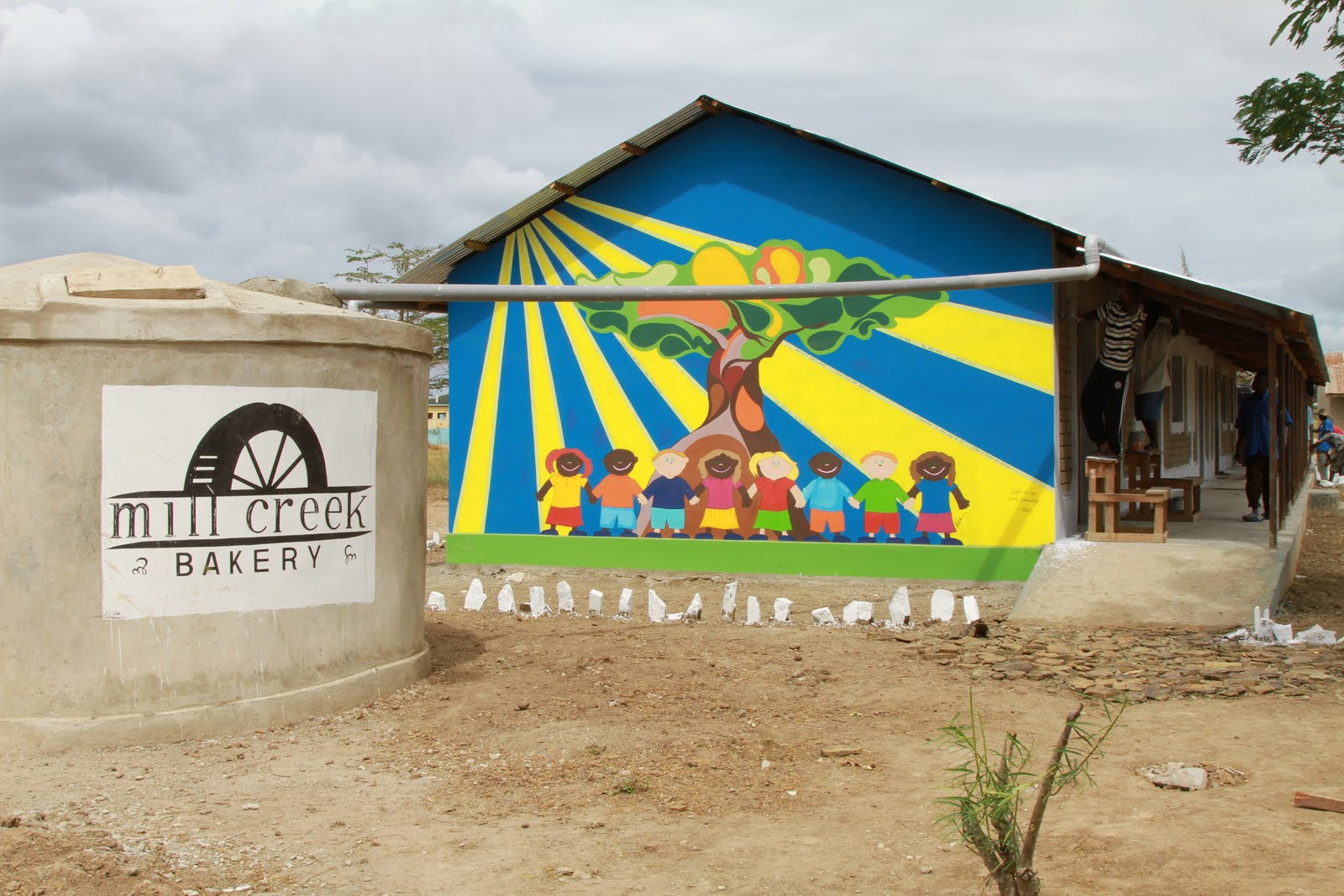
| Examples of cisterns at Koins built school |
 |
| Cisterns provide water so children don't need to bring water to school |
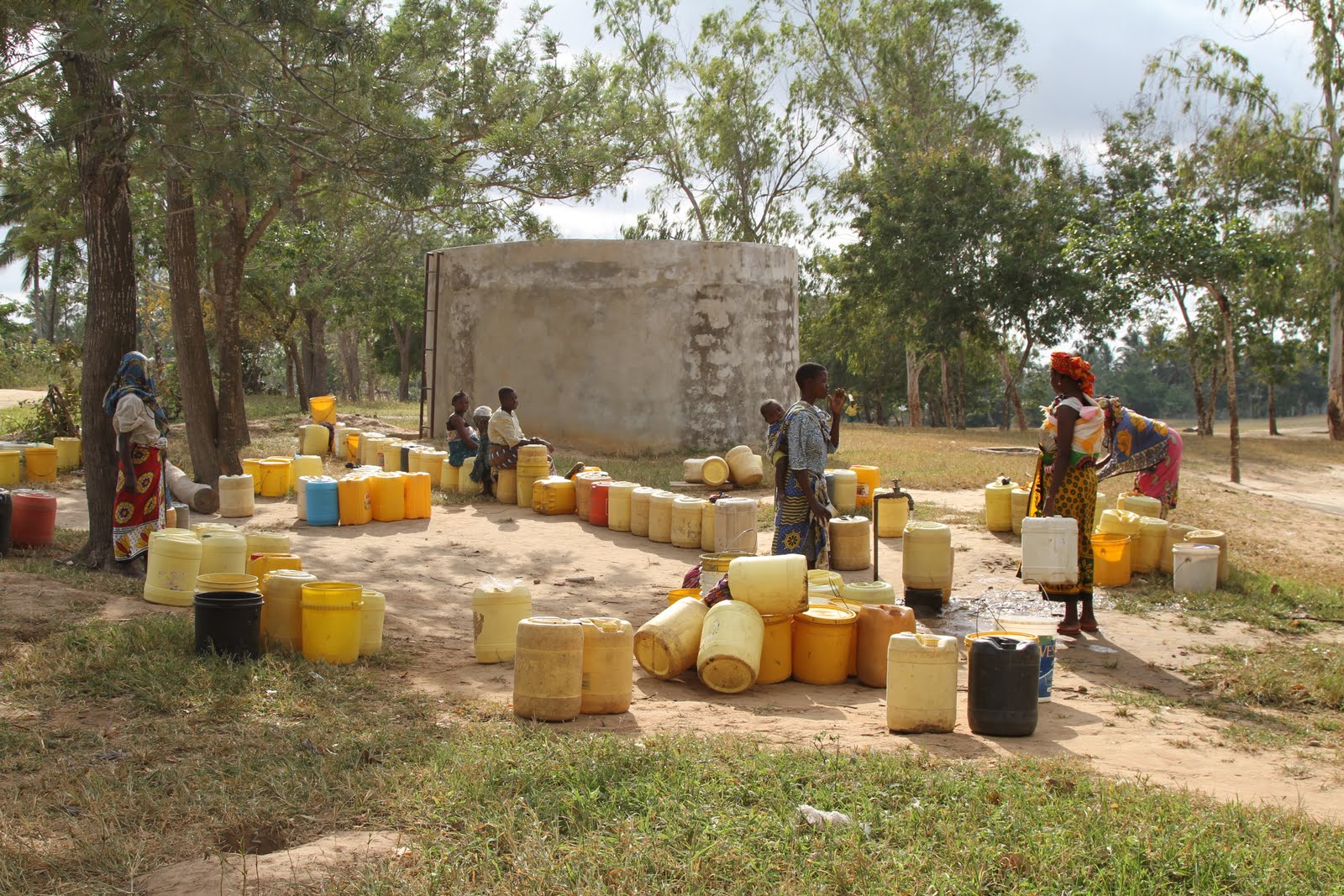
One day we are driving to Miyani to teach our lessons in the school. I notice a trail of yellow in the distance. As we get closer I notice the trail of yellow is water containers, all lined up in a row. “What is happening there?” I ask. It is explained that there is a water tap/faucet and the women bring their water containers and line them up, waiting their turn to get water. The faucet is only turned on at certain times so they leave their empty containers in a line. Later in the morning I notice the women have come back to wait with their containers. I go over to talk to them and take some photos, they don’t speak English so I can only watch. The faucet is turned on and each one fills up her container as the water slowly flows out, when it is full she lifts it on her head and walks home. Wow, another fascinating moment, they are lining up and waiting for water!! In America we get frustrated if there is no ice in our drink, these women are waiting for water!!!
 |
| Women wait at water tap in Miyani to fill their buckets |

On Sunday we go to church in Mombasa. Afterwards we eat at a restaurant before going back to the village. We are accompanied by a darling 19 year old girl named Leah. I have the good fortune of sitting next to her and getting to know her. After a while I am chatting with my fellow expeditioners about our lives back home. We start talking about the many thefts in our neighborhoods, houses broken into, bikes and snowboards stolen out of our garages, etc. Leah tells me she went to a secondary boarding school that was in a particularly dry area. Each student, male and female, was responsible for getting his or her own water. This meant they had to walk to get water every morning and evening. The water was scarce and added manual labor to an already busy day of studying and learning. Fellow students stole your water while you were in class. This became such a problem that they built locked boxes for your water bucket. Each day you locked your water in a box so other students wouldn’t be able to steal it. OH MY!!! We are complaining about stolen sports equipment and she tells us about stolen water!
 |
| Candace and Leah |
One afternoon I am able to shadow a woman in the village named Betty. She speaks excellent English so I am able to communicate with her and ask her many questions about her daily life. She washes the tin pots, rinses her hands, cooks, does laundry, and drinks with the same water. She teaches me to smash and grind the corn. Betty and her daughter-in-law pick up every kernel that falls in the dirt and place it back in the bowl. We make ugali (thick corn meal mush) for the children that stand outside her home. We pick corn and vegetables in her shamba.
 |
| Candace grinds corn |
 |
| Candace makes ugali |
 |
| Betty and her daughter pound the corn |
She tells me we are going to get water. Previous experience tells me I can’t carry 5 gallons so I opt for a smaller container. We walk 20 minutes with our empty containers. We get to the watering hole and it has a locked gate. She unrolls her kanga cloth, the one she will wear on her head to create a somewhat flat surface, sets it on the ground, sits down, pats the ground next to her and says, “sit down, we wait”. “How long do you usually wait?” I ask. “Don’t know, sometimes 10 minutes, sometimes 3 hours,” she responds.
 |
| Waiting for the water hole gate to be unlocked |
 |
| Locked gate in front of watering hole |
As we wait women and children begin to stream into the area, all with empty water containers, waiting for water. I count 70-75 people, all gathered around, chatting, children playing, everyone waiting. It is a surreal moment, Kenyan women and children, and me, just me, waiting for water. We wait 45 minutes until someone comes to open the gate. We fill our containers, once again, everyone is watching me as I make an attempt to carry the water on my head. I can hold it there for a short time, but still can’t balance, I opt to carry it as I have chosen 2 containers with handles. As we are walking back to Betty’s house, a few English speakers yell out as they pass by, “carry it on your head”. If I only could!
 |
| Koins group visits the classrooms at Boyani |
Another day we are told to get in the vans, we are going to a school that is further away, we won’t be teaching, we are just going there. We do as we are told, pile into the vans, drive on more dusty bumpy roads to Boyani. Young children are playing in the yard, some of them cry and run away when they see white people. The teachers are thrilled to see us.
 |
| A class is held under a tree, as there is no room available |
I notice there is a chalkboard nailed to a tree with benches in front of it for use as a classroom. We go into one of the classrooms made of sticks and packed mud, light streams in through the straw roof. We talk to the teachers, play a bit with the children, take some pictures, and stare back at the children who are mesmerized by us. I quickly notice there are no water containers in the classroom. Since there is no water at most schools, the children bring their own water to school each day. I have grown accustomed to seeing yellow water containers lined up in the back of the classroom or sitting next to the students. Hmm, where is the water I wonder. “How come the children don’t bring water containers to school?” I inquire. “Because there is no water,” the teacher responds. He tells us the closest watering hole has dried up as it is the dry season. The next closest one has elephants drinking from it. Last year a girl was killed by an elephant so the people are afraid to go there, yet some of them do. The next closest is very far away, they walk 5-6 kilometers to get water in the rainy season and up to 10 K in the dry season. I asked if any of the children at school had water or food to eat before they came to school, he said, “no”. There is so little water and the elephants have trampled many of the cornfields. The women may walk to water while their children are at school, that water will provide one meal in the evening. He claims 500 children would be at that school if they had water, food, and classrooms, only 200 now attend. When we leave the school we are silent in the vans. Wow, no water, elephants at the watering hole, elephants trampling the corn fields, it is a lot to take in. I struggle to wrap my brain around the lack of water here and the abundance of water at home.
 |
| Local women gather for a meeting with visitors from America |
Word travels fast that a group of Americans are staying at the KCC. A meeting is set up for the women of the local villages and everyone wants to be involved. Women and children gather in the church next to the KCC. Ingrid wants me to count how many are in attendance. At one point I count 67 women and 75 children. More women stream through the doors, most with a baby on her back and many with toddlers. They all shift places on the benches and I lose track of the numbers.
 |
| Candace at women's meeting |
They are beautiful, so beautiful, black skin with dark eyes, broad noses, thick lips, most with short cropped hair, some with tight rows of braids, many with brightly colored scarves or cloths wrapped around their heads, shirts of varying types and colors, women wearing brightly colored kanga cloth skirts, some with flip flops, most with bare feet, all with dirty feet. Babies tied to the back with a cloth are shifted to the front for convenient nursing. I live in the moment, I cherish this experience. I love it here, I love these people. I love every moment of teaching and serving the people of rural Kenya. I notice no one carries water or a snack. Many speak a little bit of English but most don’t speak any English.
 |
| Naomi conducts women's meeting |
Our interpreter, Naomi, interprets what Cindy has to say. Naomi is dressed in pants which is very unusual for this area. She carries her baby on her hip in a more western way. Cindy begins the meeting and welcomes the women with appreciation and love. “What is your number one, first and foremost problem that you would like to discuss?” asks Cindy through our interpreter. She restates the question by adding, “what is your biggest problem, how can we make your lives easier?” “Water, we need more water,” they state in unison. “We need more wells, we need more cisterns, we need ways to get more water.” Water, the answer is water. Water is their number one concern! A lengthy discussion takes place about water and water rights. Watching and listening to these women confirms my belief in the strength of women worldwide.
 |
| Young mother and baby at women's meeting |
We end the meeting and they ask us to sing and dance. Ingrid, Cindy, Sarah, and I have to quickly come up with something that we all know to entertain them. In an ironic twist we sing the primary song “Give Said the Little Stream”. “Give said the little stream as it hurried down the hill”, we sing, we make up exaggerated actions for the song as we go along. The meeting is over, I leave and go to the KCC next door and get a drink of water.
Our trip has ended. We all make the long journey home. Once in my own home I take a hot shower, warm water flows over my body. I turn on the faucet, water flows freely, I brush my teeth, fill a large glass full of water and drink. The next morning I am awakened by the sound of automatic sprinklers watering my lawn and flowers. I get up, we eat breakfast together, I put the dishes in the dishwasher and turn it on. Did you know a dishwasher uses 15 gallons of water each time you start it? I put my clothes in the washing machine, my husband leaves to wash his car. My friends are anxious to hear about my trip so we plan to meet at the local watering hole, commonly known as a swimming pool, a place where people play in thousands of gallons of water. It has a splash pad next to it, water gushes up from the ground. I watch as the children, friends, and families are frolicking in the water, screaming and squealing with delight. I am unable to speak, caught in the irony of the moment. Tears are near the surface, to avoid them spilling onto my cheeks I ask my friends what has been happening with them while I was away. One bought a new dishwasher, she said the heating element isn’t very strong so the water pools at the top of the glasses on the top rack. Another friend has a new front loading washer and dryer, she complains that they couldn’t afford the pedestals to set them on so she has to lean over to take the clothes in and out of the machines. A lifeguard blows his whistle at someone to quit running, the water makes the surface slippery. Children go off the diving boards and down the slides into the pool of water. We talk and laugh while we drink our flavored water. When I get home a begin reading the book, A Long Walk to Water by Linda Sue Park. I can’t focus on the book, my brain is scrambling, my brain is on overload, I can’t process such differing experiences. I am completely immobilized. I must find ways to raise money for the people in the Kinango District of Kenya. I stare into space and think about water. Water. Water is Life. Water.
______________________________________________________
Through a donation from LDS Humanitarian, there are three borehole wells in the Koins service area. Ultimately, we hope to have more of these kinds of wells available to the villagers, to provide fresh, clean water, at an accessible distance.
Water is available to the villagers of the Koins service area from these sources:
- Above ground watering holes and rivers, subject to seasonal drought, disease, filth. Also used by animals as their water source.
- Water cisterns. Unavailable to the average rural Kenyan due to cost and the need for a tin roof and gutter to capture water. Koins for Kenya builds cisterns alongside the schools we build, to capture rainwater and eliminate the need for children to bring water to school.
- Water taps. The Kenyan government has provided water taps, such as the one Candace described on the outskirts of the Miyani school. They are sparsely located, and the water does not always run. They are subject to broken pipes and spigots. When they work, they are a precious source of water to villagers.
- Bore hole wells. These are costly, and need upkeep, but provide a clean, unlimited source of fresh water. Currently limited to three wells in the Koins service area.
- An occasional water truck, sent by a humanitarian organization, will drive through more remote villages to deliver water. Women will come running with their buckets to fill, eeking one more days worth of this life giving substance.
Koins for Kenya is looking into a cheaper way to bore wells. There is technology available that doesn't cost as much as a traditional machine drilled bore hole. Using this new technology, it might be possible to provide a well for as little as $3,000 each. We will be looking for sponsors to help us purchase the initial equipment. at a cost of $4,000 - $5,000, and provide the $3,000 wells in various villages. It would be ideal to provide a well within reasonable walking distance of each village we serve. Truly, water is life in Kenya.
Asante sana,
IVL