Recently a group representing CrossFit was in Kenya. Marty Cej, a Business News Network anchor from Toronto, Canada was with the group, filming, interviewing and observing life in rural Kenya. This clip was shown on the BNN station this morning. It is a great overview from the perspective of a newcomer to Kenya, with photos and experiences he had while there.
Click on this link to watch the video. There is a brief ad at the beginning of the clip.
http://watch.bnn.ca/business-day/november-2012/business-day-november-10-2012/#clip804617

Showing posts with label Water. Show all posts
Showing posts with label Water. Show all posts
Monday, November 12, 2012


Wednesday, November 7, 2012
Daryle Shadows Mama Frida
Daryle Stafford is in Kenya with Bret. Daryle and Veracity Insurance are sponsoring the building of two classrooms and a cistern. The following is Daryle's experience of shadowing a villager.
Daryle shadowed Mama Frida (Free-dah) for a half day today. He fetched water from over a mile away, carrying two buckets instead of the traditional single bucket. He also worked like a horse in the garden, helping weed a substantial part of their fields. He not only fetched firewood, but he climbed a cashew nut tree and cut down dead limbs with a machete, then carried the bundle of wood back on his head to Mama Frida's house. What he really did today was learn the difficulty of being a woman in this part of the world. Mama Frida loved him because he was so strong and really dug in and got some work done. The sweat poured off of him all day in buckets. His bald dome was never without puddles ready to roll off onto his soiled shirt. His shorts were soaked through, but he continued on working side by side with Mama Frida and her family.
I would expect that some of the villagers might have a hard time telling Bret and Daryle apart. With their bald heads, blue eyes and large American bodies, they look strikingly similar!
 |
| This photo was taken in the family room of Mama Frida's home shortly after returning from the fields |
Daryle shadowed Mama Frida (Free-dah) for a half day today. He fetched water from over a mile away, carrying two buckets instead of the traditional single bucket. He also worked like a horse in the garden, helping weed a substantial part of their fields. He not only fetched firewood, but he climbed a cashew nut tree and cut down dead limbs with a machete, then carried the bundle of wood back on his head to Mama Frida's house. What he really did today was learn the difficulty of being a woman in this part of the world. Mama Frida loved him because he was so strong and really dug in and got some work done. The sweat poured off of him all day in buckets. His bald dome was never without puddles ready to roll off onto his soiled shirt. His shorts were soaked through, but he continued on working side by side with Mama Frida and her family.
 | ||
Monday, February 6, 2012
Orion Jr. High Fundraiser


Students at Orion Jr. High raise funds for a well in Kenya
Koins received a check over the weekend from Orion Jr. High School in Harrisville, Utah for just over $2,500. I corresponded by email with the principal of Orion, Kirt Swalberg, and this is what he told me about the fundraiser:
"It was a whole school effort. We showed part of your video clip about what the Kenyans had to do to get clean water and then I challenged them to raise $ 2,500 for a well. We had a 7th period class competition to see which class could bring in the most money. Our leadership hung up posters and promoted the project. The students had a great time and were excited to help. We look forward to seeing pictures of the well. It will be a nice thing for our students to see that they did make a difference."


What a pleasure it is to see young people making an effort to help those less fortunate. Their efforts will provide a fresh water well to a rural village in Kenya, allowing the women of that village to access clean water more easily. Their efforts will provide a life changing water source to an entire village.
 |
| A Kenyan woman walking home after fetching water from a pond |
Asante sana, Orion!
IVL
Monday, December 19, 2011
Analysis of the Koins/SRA Projects in Mnyenzeni
Analysis of the Koins for Kenya
and Self Reliant Agriculture Projects in Mnyenzeni
By Lonny J. Ward, M.S., M.B.A.
Endowed Prosperity International
From October 28th to November 10th I had the opportunity to work in the village of Mnyenzeni with Koins for Kenya (Koins) and The Institute for Self Reliant Agriculture (SRA). My purpose in going there was to evaluate the program and to assist in designing and implementing a goat milking project. The following is a report of my visit and an evaluation of the SRA program and the Koins project in general.
Overview
The Koins for Kenya project is very impressive. The key to the success of the project lies with Bret Van Leeuwen and his love for the Kenyan people. Bret has surrounded himself with some good people to help carry the work forward but the project still rests heavily on his shoulders. There are great synergies between the local Kenyan people and the American staff. This cooperation has led to a very efficient use of the funds raised by the Koins staff.
The focus of Koins for Kenya is to improve the education of children by building and furnishing schools. There have been 5000 to 6000 children taught in these new and improved school facilities. Thousands of other people have been positively influenced by Koins’ presence in the Mnyenzeni area as the Koins’ projects have gone forward.
By combining Koins’ efforts with SRA it is hoped that their influence will reach broader and deeper into the lives of the Kenyan people. Families will be educated and assisted in developing their own gardens and small farms that will greatly improve their diets and eventually provide them a significant source of income. The focus of this project is to improve their diets so that the people will be healthier and the children will grow and learn better. There have been instances where improvements in the student’s diets have already had dramatic positive effects on their ability to learn. SRA and Koins together make a good team.
The Institute for Self Reliant Agriculture (SRA)
The focus and goals of the SRA are to help the villagers become self reliant by growing their own food. This goal is reached through a program where the SRA staff teach and train the local population how to raise their own food. Most of these villagers have access to land where they can plant gardens and raise animals but the land is not used efficiently. The SRA model is very appropriate for this situation where the resources are available but not well used. The program’s success depends a great deal on the ability of the staff to inspire and teach the villagers and the willingness of the villages to make the plan work.
Koins provides a fertile location for the SRA to implement its program. The structure is such that the SRA staff can set up their demonstration plots on the Koins’ land. The trust that the Koins staff has earned among the villages is critical to their acceptance of the program. This trust and respect can be leveraged by SRA as they start to teach the people. As the SRA program succeeds, the people can better feed themselves. As a result the students will do better in school. There will be more money produced and retained in the village. The combined Koins and SRA projects give the people the tools to lift themselves out of poverty and starvation.
SRA Staff
Tom Rasmussen is the vice president of The Institute for Self Reliant Agriculture (SRA) and has been the face of the SRA in Kenya. He has limited experience with agriculture but has a passion about the program that is key to its success. Tom hired two well qualified Kenyans, Patrick and Eddison, as the animal and garden experts. They are both well qualified for those positions and are aggressively pushing the project forward. SRA is able to leverage the Koins’ Kenyan staff so they can run very efficiently. As the project expands it will be necessary to hire additional staff to coordinate the project.
Rotational Garden
The rotational garden is set up to produce all year round. Each garden is divided into four sections that are planted several weeks apart in a rotational system. At least one of the garden sections is producing and ready to harvest at all times. Each of the four garden sections contains similar crops which are customized to the nutritional needs of the family and the availability of water.
Eddison has four plots set up and two of them planted. These gardens are well on their way to producing food. In addition to the traditional gardens they have a nursery for starting the plants. The seeds start out planted closely together, then once they have grown a couple of inches tall they are transplanted to the regular gardens. This is a way of jump starting the program for those who are planting their first garden.
Another innovative idea that they are working on is the “feed sack” garden. The feed sack is filled with soil and has seeds planted both on the top and in small holes on the side of the sack. Because of its compactness and vertical positioning it is very efficient in its use of water. Villagers can wash their hands and face above the sack and the water that falls onto the sack can provide enough water for the plants to grow.
The principle purpose of the rotational gardens is to provide a balanced diet to the family first. Once the needs of the family are met, surplus produce could be sold providing some income to the family. The family would be better off because they have a balanced diet and some additional income. The community would be better off because there would be more food for consumption. This would result in a net increase in the economic prosperity of the village. Less money would be going out of the village for food, and more money would come into the village as food was sold to the surrounding areas. For example, the tomatoes sold in the Mnyenzeni store and purchased in Mombasa but are grown near Nairobi. Mnyenzeni could easily grow their own tomatoes and sell their surplus to markets in Mombasa.
Animal Projects
Chickens
The chicken project was created to teach families how to raise chickens in a small enclosure near their home. The eggs are collected and stored by the family in a cooling chamber. This is done so that the laying hens will continue laying eggs instead of just nesting. One or more hens will be selected to nest on a dozen eggs at a time for the 21 day incubation period.
As chicks hatch out of the eggs, they are separated into a nursery and new eggs are introduced to be incubated. Using this method, Mwayele, a neighboring farmer, has raised close to 2000 chickens from an original flock of 12 hens in only two years. The sale of these chickens paid his children’s school tuition and gave him seed money to start a goat project.
Patrick has set up a hen house next to the garden area on the Koins compound. The structure has layer hen boxes on one side, a roosting area in the middle and a nesting area on the other side. The structure is built up off the ground so that the manure and urine will fall through the floor onto the ground below. This model keeps the pen clean, breaks the cycle of internal parasites and makes it easy to gather the manure to use as fertilizer on garden plots.
The hen house was made from locally available materials by a local builder and will be used as a model to build smaller hen houses for village families. It will also be used in the training program for the villagers. Families will be given training and a few chickens with the expectation that they will return the chickens once they have offspring.
An important part of this project is to require the villagers to purchase or earn everything that they receive so that they will feel ownership of their project. Patrick’s goal is for each family to be able to eat one chicken weekly as part of their diet. They will also have enough eggs that each person in the family can eat one egg weekly. The rest of the eggs will be used for growing the flock. Even though this may seem like a small amount, the nutritional benefits will be enormous compared to the low-protein diet that the majority of villagers normally eat.
With proper training and ongoing support from the SRA, each family could be successful at raising chickens. These chickens would provide food for the family, a source of income and fertilizer for their rotational gardens. It would be an achievable step for them and make a significant positive impact for the community.
Goats
The purpose of the goat project is to raise goats that will provide both milk and meat for the local schools and eventually for families. SRA and Koins will develop a goat herd that will be used for training. This herd will also produce goats for sale to the schools and families that have been trained. The schools will use the goats to provide milk for their lunch program. The villagers and the school children will learn firsthand how to care for the goats properly.
The milk from the Koins herd will also be made available to the local dispensary to be used for babies that cannot receive milk from their mothers due to AIDS, other illnesses or death. Goats that are not used for milking or breeding will be slaughtered for meat.
The greatest immediate effect of this project will be the milk for babies and young children. In some cases this milk will be life-saving, either immediately or in the long run. The milk will provide critical nutrients that will help with their general health and their physical and mental development. There will likely be an increase in the test scores of the children who receive milk at school.
Mwayele is a nearby farmer that has participated in Patrick and Eddison’s animal program and currently has 90 goats. Among his herd are Gala goats that are faster growing and produce more milk than the local breeds. They are doing well on his farm and would be a good choice for the Mnyenzeni area.
In two years, Mwayele has gone from a poor farmer with 12 chickens to a successful farmer with 300 chickens and 90 goats. He has been able to feed and care for his wife, four children and his two nephews after their parents died. He has now opened a small store and has purchased a solar panel that provides electricity to the store and home.
Mwayele purchased his goats at Eicheha Farm in Taveta so Patrick and Lonny went there to identify the best goats to use for the training herd. They selected 3 males and 21 females from among the best goats on the farm. The goats had been recently vaccinated and were ready for transport to Mnyenzeni at the end of November.
Using local materials and laborers, a goat house was built to be used for the Gala goat herd. Bret and the Koins staff worked out an agreement with the neighboring school to harvest their grass. The grass will be dried and stored to be fed during the dry season.
The goat project will be more complicated than the other projects and require more training and follow up by the SRA staff. However, if managed correctly, this project has the most potential for dramatically changing the community. This is because the goats will provide enough income for a father to provide for his family without having to procure outside work. Currently many of the men leave home and travel to Mombasa to work a week at a time, leaving their families without a father for long periods of time. This social situation causes many problems which can be resolved if the fathers are able to work in their own village and be with their families. Overall, the goat project can and will have a major positive effect on the community.
Water
A critical component in the lives of these people and a major focus for Koins and the SRA is providing them with clean water. There are two rainy seasons where water is plentiful, but these seasons are separated by months of very dry conditions where water becomes scarce. There is one small water line that runs past the village and provides a little water to some of the people. However, most of the people obtain their water from puddles in the roads, the river bottoms or man-made storage ponds.
Koins has implemented several water storage projects and is currently implementing several other new ideas. Large water tanks have been constructed to collect rain water from the tin roofs of the community center, the church, the hospital and the dispensary. This water is much cleaner than what is collected from the rivers and puddles. A significant amount of water is collected this way but is not enough for the needs of the compound and new ideas for obtaining, cleaning and storing water are needed. As the garden and animal projects expand, it will be critical to have more water available for these projects.
Koins partnered with engineers Kevin Nielsen and Shad Roundy from CH2MHill to build a retention dam in a river bed that is near the village. This dam will provide a significant amount of water to be used for the garden and animal projects. It will also serve as a model for building additional dams in the future on this river and on others in the surrounding area.
In order to provide more clean drinking water for the village, Koins is also working with WHOlives.org which has a hand-operated well drilling machine called the “village drill”. It is hoped that the Ben Taylor Workshop on the Koins compound can serve as a manufacturing site for these village drills. It is hoped that they will be able to drill wells in all of the surrounding villages at very reasonable rates. Because of their simplicity and their manual component they can be used with a limited amount of training and skill. The villagers drill their own wells which gives them pride and ownership of the wells.
Obtaining, cleaning and storing water is critical to improving the lives of the Kenyan people and is central to the success of any projects. Koins has developed successful ways of retaining the water and is continuing to look for and develop additional water resources. The lives of these villagers will be forever improved as they learn to better use the resources that are available to them.
Summary and Analysis
Overall I am very impressed and excited about the cooperative project between Koins for Kenya and The Institute for Self Reliant Agriculture in the Mnyenzeni area. The land has incredible resources that will provide food and income for the people as they learn how to develop and utilize them. Koins has the confidence of the villagers and provides a location for training. The SRA provides the model for success and the staff to implement the training.
The SRA model of teaching basic self reliance to alleviate poverty and death has been well researched and proven successful in other areas. Because it takes time to gain the respect and confidence of the villagers in a new area, partnering with an existing organization that has already developed this confidence means that more lives are saved faster.
This same type of cooperative effort should be used in many other villages to hasten the work of teaching people how to lift themselves out of poverty and into a successful, flourishing condition. Positively changing the lives of these wonderful people is exciting and fulfilling.
and Self Reliant Agriculture Projects in Mnyenzeni
By Lonny J. Ward, M.S., M.B.A.
Endowed Prosperity International
 |
| Eddison, Patrick and Lonny |
Overview
The Koins for Kenya project is very impressive. The key to the success of the project lies with Bret Van Leeuwen and his love for the Kenyan people. Bret has surrounded himself with some good people to help carry the work forward but the project still rests heavily on his shoulders. There are great synergies between the local Kenyan people and the American staff. This cooperation has led to a very efficient use of the funds raised by the Koins staff.
 |
| Bret inspiring the school children |
The focus of Koins for Kenya is to improve the education of children by building and furnishing schools. There have been 5000 to 6000 children taught in these new and improved school facilities. Thousands of other people have been positively influenced by Koins’ presence in the Mnyenzeni area as the Koins’ projects have gone forward.
By combining Koins’ efforts with SRA it is hoped that their influence will reach broader and deeper into the lives of the Kenyan people. Families will be educated and assisted in developing their own gardens and small farms that will greatly improve their diets and eventually provide them a significant source of income. The focus of this project is to improve their diets so that the people will be healthier and the children will grow and learn better. There have been instances where improvements in the student’s diets have already had dramatic positive effects on their ability to learn. SRA and Koins together make a good team.
The Institute for Self Reliant Agriculture (SRA)
The focus and goals of the SRA are to help the villagers become self reliant by growing their own food. This goal is reached through a program where the SRA staff teach and train the local population how to raise their own food. Most of these villagers have access to land where they can plant gardens and raise animals but the land is not used efficiently. The SRA model is very appropriate for this situation where the resources are available but not well used. The program’s success depends a great deal on the ability of the staff to inspire and teach the villagers and the willingness of the villages to make the plan work.
Koins provides a fertile location for the SRA to implement its program. The structure is such that the SRA staff can set up their demonstration plots on the Koins’ land. The trust that the Koins staff has earned among the villages is critical to their acceptance of the program. This trust and respect can be leveraged by SRA as they start to teach the people. As the SRA program succeeds, the people can better feed themselves. As a result the students will do better in school. There will be more money produced and retained in the village. The combined Koins and SRA projects give the people the tools to lift themselves out of poverty and starvation.
SRA Staff
Tom Rasmussen is the vice president of The Institute for Self Reliant Agriculture (SRA) and has been the face of the SRA in Kenya. He has limited experience with agriculture but has a passion about the program that is key to its success. Tom hired two well qualified Kenyans, Patrick and Eddison, as the animal and garden experts. They are both well qualified for those positions and are aggressively pushing the project forward. SRA is able to leverage the Koins’ Kenyan staff so they can run very efficiently. As the project expands it will be necessary to hire additional staff to coordinate the project.
 |
| Tom, Patrick and a worker at the Rotational Garden and Hen House |
Rotational Garden
The rotational garden is set up to produce all year round. Each garden is divided into four sections that are planted several weeks apart in a rotational system. At least one of the garden sections is producing and ready to harvest at all times. Each of the four garden sections contains similar crops which are customized to the nutritional needs of the family and the availability of water.
Eddison has four plots set up and two of them planted. These gardens are well on their way to producing food. In addition to the traditional gardens they have a nursery for starting the plants. The seeds start out planted closely together, then once they have grown a couple of inches tall they are transplanted to the regular gardens. This is a way of jump starting the program for those who are planting their first garden.
Another innovative idea that they are working on is the “feed sack” garden. The feed sack is filled with soil and has seeds planted both on the top and in small holes on the side of the sack. Because of its compactness and vertical positioning it is very efficient in its use of water. Villagers can wash their hands and face above the sack and the water that falls onto the sack can provide enough water for the plants to grow.
The principle purpose of the rotational gardens is to provide a balanced diet to the family first. Once the needs of the family are met, surplus produce could be sold providing some income to the family. The family would be better off because they have a balanced diet and some additional income. The community would be better off because there would be more food for consumption. This would result in a net increase in the economic prosperity of the village. Less money would be going out of the village for food, and more money would come into the village as food was sold to the surrounding areas. For example, the tomatoes sold in the Mnyenzeni store and purchased in Mombasa but are grown near Nairobi. Mnyenzeni could easily grow their own tomatoes and sell their surplus to markets in Mombasa.
Animal Projects
Chickens
The chicken project was created to teach families how to raise chickens in a small enclosure near their home. The eggs are collected and stored by the family in a cooling chamber. This is done so that the laying hens will continue laying eggs instead of just nesting. One or more hens will be selected to nest on a dozen eggs at a time for the 21 day incubation period.
As chicks hatch out of the eggs, they are separated into a nursery and new eggs are introduced to be incubated. Using this method, Mwayele, a neighboring farmer, has raised close to 2000 chickens from an original flock of 12 hens in only two years. The sale of these chickens paid his children’s school tuition and gave him seed money to start a goat project.
 |
| Eddison and Patrick with a trainee in front of the hen house |
Patrick has set up a hen house next to the garden area on the Koins compound. The structure has layer hen boxes on one side, a roosting area in the middle and a nesting area on the other side. The structure is built up off the ground so that the manure and urine will fall through the floor onto the ground below. This model keeps the pen clean, breaks the cycle of internal parasites and makes it easy to gather the manure to use as fertilizer on garden plots.
The hen house was made from locally available materials by a local builder and will be used as a model to build smaller hen houses for village families. It will also be used in the training program for the villagers. Families will be given training and a few chickens with the expectation that they will return the chickens once they have offspring.
An important part of this project is to require the villagers to purchase or earn everything that they receive so that they will feel ownership of their project. Patrick’s goal is for each family to be able to eat one chicken weekly as part of their diet. They will also have enough eggs that each person in the family can eat one egg weekly. The rest of the eggs will be used for growing the flock. Even though this may seem like a small amount, the nutritional benefits will be enormous compared to the low-protein diet that the majority of villagers normally eat.
With proper training and ongoing support from the SRA, each family could be successful at raising chickens. These chickens would provide food for the family, a source of income and fertilizer for their rotational gardens. It would be an achievable step for them and make a significant positive impact for the community.
Goats
The purpose of the goat project is to raise goats that will provide both milk and meat for the local schools and eventually for families. SRA and Koins will develop a goat herd that will be used for training. This herd will also produce goats for sale to the schools and families that have been trained. The schools will use the goats to provide milk for their lunch program. The villagers and the school children will learn firsthand how to care for the goats properly.
The milk from the Koins herd will also be made available to the local dispensary to be used for babies that cannot receive milk from their mothers due to AIDS, other illnesses or death. Goats that are not used for milking or breeding will be slaughtered for meat.
The greatest immediate effect of this project will be the milk for babies and young children. In some cases this milk will be life-saving, either immediately or in the long run. The milk will provide critical nutrients that will help with their general health and their physical and mental development. There will likely be an increase in the test scores of the children who receive milk at school.
Mwayele is a nearby farmer that has participated in Patrick and Eddison’s animal program and currently has 90 goats. Among his herd are Gala goats that are faster growing and produce more milk than the local breeds. They are doing well on his farm and would be a good choice for the Mnyenzeni area.
 |
| Mwayele showing his goats and chickens to the Koins and SRA group |
In two years, Mwayele has gone from a poor farmer with 12 chickens to a successful farmer with 300 chickens and 90 goats. He has been able to feed and care for his wife, four children and his two nephews after their parents died. He has now opened a small store and has purchased a solar panel that provides electricity to the store and home.
Mwayele purchased his goats at Eicheha Farm in Taveta so Patrick and Lonny went there to identify the best goats to use for the training herd. They selected 3 males and 21 females from among the best goats on the farm. The goats had been recently vaccinated and were ready for transport to Mnyenzeni at the end of November.
Using local materials and laborers, a goat house was built to be used for the Gala goat herd. Bret and the Koins staff worked out an agreement with the neighboring school to harvest their grass. The grass will be dried and stored to be fed during the dry season.
 |
| Lonny, Patrick, Tom and Eddison with school children taking a short break from the construction of the new goat house |
The goat project will be more complicated than the other projects and require more training and follow up by the SRA staff. However, if managed correctly, this project has the most potential for dramatically changing the community. This is because the goats will provide enough income for a father to provide for his family without having to procure outside work. Currently many of the men leave home and travel to Mombasa to work a week at a time, leaving their families without a father for long periods of time. This social situation causes many problems which can be resolved if the fathers are able to work in their own village and be with their families. Overall, the goat project can and will have a major positive effect on the community.
Water
A critical component in the lives of these people and a major focus for Koins and the SRA is providing them with clean water. There are two rainy seasons where water is plentiful, but these seasons are separated by months of very dry conditions where water becomes scarce. There is one small water line that runs past the village and provides a little water to some of the people. However, most of the people obtain their water from puddles in the roads, the river bottoms or man-made storage ponds.
 |
| The water storage tank that collects the water from the KCC roof |
Koins has implemented several water storage projects and is currently implementing several other new ideas. Large water tanks have been constructed to collect rain water from the tin roofs of the community center, the church, the hospital and the dispensary. This water is much cleaner than what is collected from the rivers and puddles. A significant amount of water is collected this way but is not enough for the needs of the compound and new ideas for obtaining, cleaning and storing water are needed. As the garden and animal projects expand, it will be critical to have more water available for these projects.
Koins partnered with engineers Kevin Nielsen and Shad Roundy from CH2MHill to build a retention dam in a river bed that is near the village. This dam will provide a significant amount of water to be used for the garden and animal projects. It will also serve as a model for building additional dams in the future on this river and on others in the surrounding area.
 |
| Kevin and Shad surveying damage after a sudden downpour |
 |
| Kevin, Buffalo and Lonny as dam construction continues |
In order to provide more clean drinking water for the village, Koins is also working with WHOlives.org which has a hand-operated well drilling machine called the “village drill”. It is hoped that the Ben Taylor Workshop on the Koins compound can serve as a manufacturing site for these village drills. It is hoped that they will be able to drill wells in all of the surrounding villages at very reasonable rates. Because of their simplicity and their manual component they can be used with a limited amount of training and skill. The villagers drill their own wells which gives them pride and ownership of the wells.
Obtaining, cleaning and storing water is critical to improving the lives of the Kenyan people and is central to the success of any projects. Koins has developed successful ways of retaining the water and is continuing to look for and develop additional water resources. The lives of these villagers will be forever improved as they learn to better use the resources that are available to them.
Summary and Analysis
Overall I am very impressed and excited about the cooperative project between Koins for Kenya and The Institute for Self Reliant Agriculture in the Mnyenzeni area. The land has incredible resources that will provide food and income for the people as they learn how to develop and utilize them. Koins has the confidence of the villagers and provides a location for training. The SRA provides the model for success and the staff to implement the training.
The SRA model of teaching basic self reliance to alleviate poverty and death has been well researched and proven successful in other areas. Because it takes time to gain the respect and confidence of the villagers in a new area, partnering with an existing organization that has already developed this confidence means that more lives are saved faster.
This same type of cooperative effort should be used in many other villages to hasten the work of teaching people how to lift themselves out of poverty and into a successful, flourishing condition. Positively changing the lives of these wonderful people is exciting and fulfilling.
 |
| Patrick, Lonny, Eddison and Jones in front of completed goat house |
Friday, December 9, 2011
The Village Well
During 2011, Koins for Kenya partnered with WhoLives.org, an organization that has developed a human powered drill for more affordable water well drilling.

This Village Drill is very suitable for rural villages that are off the beaten path, with limited or no accessibility to the traditional large drilling rigs needed to drill a well. This is new technology that has the potential to change the face of rural third world poverty and water related issues.
With the BTW workshop already in place in the Koins service area, we are preparing to work with WhoLives.org to manufacture and distribute these hand operated drills throughout Africa in 2012. We are excited about the possibilities. Clean and accessible water has always been a problem in the Koins service area, and in many third world countries around the world.
Here are a few water related facts:
• 884 million people lack access to safe water supplies; approximately one in eight people.
• 3.75 million People die each year from water-related disease, 84% are children.
• Diarrhea causes 1.4 million children’s deaths every year. More than AIDS, malaria and measles
combined.
• The ability to bring clean safe drinking water to impoverished nations is the number one concern of governments and NGO's, yet the problem still remains wholly unsolved.
Here is a short video about the Village Drill:
With the help of LDS Humanitarian, Koins has established 3 wells within our service area in the past. Each well cost over $10,000 to provide. The Village Drill will allow a perpetual water source to be provided, at a cost of approximately $3,500 per well. In addition to the gift of fresh water, the Village Drill project will also provides jobs to Kenyans, both on the manufacturing side, and in the labor of the actual well drilling.
Your donations are needed now more than ever. We have a real chance of creating a new world at a cost of about $2 per person. A $3,500 donation will bring clean, fresh, accessible water to an entire village. Join us today and be a part of history. Donate here. Choose Water Projects as your donation destination.
Asante Sana!
IVL

This Village Drill is very suitable for rural villages that are off the beaten path, with limited or no accessibility to the traditional large drilling rigs needed to drill a well. This is new technology that has the potential to change the face of rural third world poverty and water related issues.
With the BTW workshop already in place in the Koins service area, we are preparing to work with WhoLives.org to manufacture and distribute these hand operated drills throughout Africa in 2012. We are excited about the possibilities. Clean and accessible water has always been a problem in the Koins service area, and in many third world countries around the world.
Here are a few water related facts:
• 884 million people lack access to safe water supplies; approximately one in eight people.
• 3.75 million People die each year from water-related disease, 84% are children.
• Diarrhea causes 1.4 million children’s deaths every year. More than AIDS, malaria and measles
combined.
• The ability to bring clean safe drinking water to impoverished nations is the number one concern of governments and NGO's, yet the problem still remains wholly unsolved.
Here is a short video about the Village Drill:
With the help of LDS Humanitarian, Koins has established 3 wells within our service area in the past. Each well cost over $10,000 to provide. The Village Drill will allow a perpetual water source to be provided, at a cost of approximately $3,500 per well. In addition to the gift of fresh water, the Village Drill project will also provides jobs to Kenyans, both on the manufacturing side, and in the labor of the actual well drilling.
Your donations are needed now more than ever. We have a real chance of creating a new world at a cost of about $2 per person. A $3,500 donation will bring clean, fresh, accessible water to an entire village. Join us today and be a part of history. Donate here. Choose Water Projects as your donation destination.
Asante Sana!
IVL
Wednesday, November 23, 2011
Fighting Hunger in Kenya
This article came from the BYU campus newspaper, published 11/20/11. Dr. Paul Johnston, a professor at BYU and affiliated with the organization Self Reliant Agriculture, has been working with Koins for several months now, and the results are developing into an education based program to help villagers learn to grow year-round, nutritious gardens that can feed their families.
______________________________________
The daily ration for a 10-year-old child in Kenya might include getting a fist-sized portion of ugali, ground-up corn with water; a tortilla-sized piece of mandazi, a kind of fried bread; and a serving of dried fish, equivalent to five guppy fish. That’s only 30 percent of the total daily calories a child that age should eat.
Professor of nutritional science Paul Johnston is working with BYU students to help fix this problem affecting children across Kenya.
Johnston was invited to collaborate with Koins for Kenya, an Alpine-based nonprofit organization, to fight child hunger and starvation in Kenya by planting gardens which will provide the locals with food year-round.
Currently, locals and Koins for Kenya are working together to plant 100 gardens for families, which will begin producing food in January. The gardens are planted with a variety of foods indigenous to Africa as well as others Americans might consume. Locals will harvest the vegetables every two weeks to provide a variety of fresh food throughout the year.
“Our idea is to take the [food] we are raising and use it as a way to teach the children about nutrition,” Johnston said.
Children will be able to pick a sweet potato from the garden and know its nutritional qualities, Johnston said. Ideally, the children will be able to teach their parents about nutrition to prevent future nutrient deficiencies.
Koins for Kenya founder Bret Van Leeuwen said the program is also meant to help people be self-sufficient.
“We don’t want to create dependency,” Van Leeuwen said. “So we focused on education because that’s the way out.”
In order to get a garden, the locals volunteer to participate and learn farming techniques and practices from agricultural specialists. The gardens will work similar to a co-op, where they give up 10 percent of their crops to sell at the market. The money will go toward buying more seeds and farming equipment for future harvests.
In preparation for the gardens, Todd Gardner, a nutritional science major, analyzed the diets of the children. Koins for Kenya collected the heights, weights and diets of more than 300 children from villages across Kenya.
He compared their diets to world health standards and found the childrens’ nutrient intake was extremely deficient. Compared to world health standards, they get only 13 percent of the normal calcium intake, 8 percent of the normal vitamin C intake and 1.8 percent of the standard B12 intake.
“I took their diets to see what they were eating to see how we can implement nutrients to catch them up, in a sense, with other people,” Gardner said.
According to Johnston, Vitamin A and C deficiencies are major problems in the region. A lack of vitamin A is the leading cause of blindness in children in Sub-Saharan Africa, and other deficiencies lead to health problems like stunted growth, which about 50 percent of the children suffer from. Johnston said their heights are significantly below the norm, indicating severe malnutrition.
Luiz Belo Neto, a senior nutritional science major, is working on a booklet to be distributed to the people; it will include charts outlining the daily nutrient requirements for people of different ages, weights and genders.
Gardner said working on the project has helped him understand hunger.
“As a nutritional major … you hear about nutrition and fats and carbs,” he said. “The only experience I’ve had is with my own diet, an American diet. Their diets are so unbalanced compared to ours. We take so many things for granted. … There is food all around us.”
The gardens will ideally be a successful, lasting system.
“There is a greater chance that people are going to accept it and use it over time,” he said. “The goal is that this will be adopted as part of the society.”
Johnston hopes the idea will spread, reaching to help more people.
“Over the period of the next few years,” Johnston said, “we’d like to see as many as 1,000 gardens being planted within individual families’ homes.”
They’re off to a good start with spreading the program; Johnston also worked on a similar project that provided the same opportunity to orphans in Ecuador.
“They’d never eaten broccoli before,” Johnston said. “They’d never even heard of it.”
But working in any country with limited infrastructure and trying to implement lifestyle changes isn’t easy.
Van Leeuwen said the limited water supply is the main issue threatening the success of the gardens. There is enough water available during the rainy season, but they need a way to capture it so they have a supply for the gardens when the rainy season ends.
They have found one solution, however.
Koins for Kenya just finished a dam that will be the water supply for the gardens. Van Leeuwen helped engineer the project that will now bring water a mile closer to the people.
“It started raining literally the day that it was finished,” he said. “In a matter of a couple of hours we filled our dam to the brim … and captured millions of gallons of water that, up until that day, would run into the next river. … All the water we captured would have been wasted.”
Johnston has confidence the people will succeed in their endeavors with the gardens.
“They are ingenious … and they’ll figure out better ways to do it than we will,” he said.
________________________
Watch for a blog post with follow-up photos and descriptions of the dam project.
Asante!
IVL
______________________________________
The daily ration for a 10-year-old child in Kenya might include getting a fist-sized portion of ugali, ground-up corn with water; a tortilla-sized piece of mandazi, a kind of fried bread; and a serving of dried fish, equivalent to five guppy fish. That’s only 30 percent of the total daily calories a child that age should eat.
Professor of nutritional science Paul Johnston is working with BYU students to help fix this problem affecting children across Kenya.
 | ||
| SRA Garden at the Koins Community Center in Mnyenzeni, Kenya |
Photo by Paul Johnston
Currently, locals and Koins for Kenya are working together to plant 100 gardens for families, which will begin producing food in January. The gardens are planted with a variety of foods indigenous to Africa as well as others Americans might consume. Locals will harvest the vegetables every two weeks to provide a variety of fresh food throughout the year.
“Our idea is to take the [food] we are raising and use it as a way to teach the children about nutrition,” Johnston said.
Children will be able to pick a sweet potato from the garden and know its nutritional qualities, Johnston said. Ideally, the children will be able to teach their parents about nutrition to prevent future nutrient deficiencies.
Koins for Kenya founder Bret Van Leeuwen said the program is also meant to help people be self-sufficient.
“We don’t want to create dependency,” Van Leeuwen said. “So we focused on education because that’s the way out.”
In order to get a garden, the locals volunteer to participate and learn farming techniques and practices from agricultural specialists. The gardens will work similar to a co-op, where they give up 10 percent of their crops to sell at the market. The money will go toward buying more seeds and farming equipment for future harvests.
In preparation for the gardens, Todd Gardner, a nutritional science major, analyzed the diets of the children. Koins for Kenya collected the heights, weights and diets of more than 300 children from villages across Kenya.
He compared their diets to world health standards and found the childrens’ nutrient intake was extremely deficient. Compared to world health standards, they get only 13 percent of the normal calcium intake, 8 percent of the normal vitamin C intake and 1.8 percent of the standard B12 intake.
“I took their diets to see what they were eating to see how we can implement nutrients to catch them up, in a sense, with other people,” Gardner said.
According to Johnston, Vitamin A and C deficiencies are major problems in the region. A lack of vitamin A is the leading cause of blindness in children in Sub-Saharan Africa, and other deficiencies lead to health problems like stunted growth, which about 50 percent of the children suffer from. Johnston said their heights are significantly below the norm, indicating severe malnutrition.
Luiz Belo Neto, a senior nutritional science major, is working on a booklet to be distributed to the people; it will include charts outlining the daily nutrient requirements for people of different ages, weights and genders.
Gardner said working on the project has helped him understand hunger.
“As a nutritional major … you hear about nutrition and fats and carbs,” he said. “The only experience I’ve had is with my own diet, an American diet. Their diets are so unbalanced compared to ours. We take so many things for granted. … There is food all around us.”
The gardens will ideally be a successful, lasting system.
“There is a greater chance that people are going to accept it and use it over time,” he said. “The goal is that this will be adopted as part of the society.”
Johnston hopes the idea will spread, reaching to help more people.
“Over the period of the next few years,” Johnston said, “we’d like to see as many as 1,000 gardens being planted within individual families’ homes.”
They’re off to a good start with spreading the program; Johnston also worked on a similar project that provided the same opportunity to orphans in Ecuador.
“They’d never eaten broccoli before,” Johnston said. “They’d never even heard of it.”
But working in any country with limited infrastructure and trying to implement lifestyle changes isn’t easy.
Van Leeuwen said the limited water supply is the main issue threatening the success of the gardens. There is enough water available during the rainy season, but they need a way to capture it so they have a supply for the gardens when the rainy season ends.
They have found one solution, however.
Koins for Kenya just finished a dam that will be the water supply for the gardens. Van Leeuwen helped engineer the project that will now bring water a mile closer to the people.
“It started raining literally the day that it was finished,” he said. “In a matter of a couple of hours we filled our dam to the brim … and captured millions of gallons of water that, up until that day, would run into the next river. … All the water we captured would have been wasted.”
Johnston has confidence the people will succeed in their endeavors with the gardens.
“They are ingenious … and they’ll figure out better ways to do it than we will,” he said.
________________________
Watch for a blog post with follow-up photos and descriptions of the dam project.
Asante!
IVL
Friday, September 30, 2011
Halloween Hustle 5K Run in Kaysville, Utah


There are lot of fun activities planned, including adult and children 5K walk/run, a costume contest, pancake breakfast and raffle prizes.
All proceeds from this activity are tax deductible, and will go directly to Koins for Kenya, for the building of a large community water cistern in Mnyenzeni, Kenya.
You can register online at: http://halloweenhustle.regtix.com
Come join this fun family event, and help Koins for Kenya build a cistern.
Asante sana!
IVL
Thursday, July 28, 2011
Water is Life (Candace's Kenyan Experience)
 |
Because of an obsession with all things African, I have decided to go to Kenya for two weeks with a humanitarian group, “Koins for Kenya”. I read every word of their website, every blog, and look at every picture. I plan and prepare, I collect items to take with me for the school children. I am excited for this amazing journey.
 |
| Kenyan women returning from water hole |
I am absolutely intrigued and fascinated by the fact that women carry 50 lbs. of water on their heads in 5 gallon buckets, with bare feet, and often a baby tied on their back. There is no way, it can’t be possible. I study the pictures and look at the artists drawing on the outside of the Koins Community Center (KCC). I am amazed, in awe, I can’t wait to see the strength of these women, I want to try it myself, I want to experience everything.
 |
| Madie, Jessie and Candace with Kenyan children, dry river bed behind them |
 |
| Young mother collecting water for her family |
 |
| Women and girls gather at water hole to fetch water |
We finally arrive in Mnyenzeni after many long hours of traveling. We take our belongings into the KCC, our two week home, receive an orientation, and find our bed. Bret informs us that we will be going on a walk in 30 minutes. He takes us on a tour of the village. Our last stop is the local watering hole, however, we don’t know that yet. You can’t see the water, it is surrounded by tree branches piled up to make a fence. Bret doesn’t tell us this is where the water is, he points out the fence, explains it keeps the animals out, “in a moment you will see why,” he tells us. We round the corner and there it is, my heart leaps, this is where the villagers get water. There are many women and children in bright colored kanga clothes collecting and carrying water. The water is a mucky dirty brown. They are dipping a milk carton type of thing with the top half cut off and a stick attached into the water and filling up yellow containers of varying sizes. Bret asks, “who wants to try?” I immediately volunteer, I don’t know my group very well, they must all think I am crazy to quickly try such a thing, and in front of all these local people. Bret tells the group there is no way any of us will be able to do this task. I take it as a challenge. He summons a teenage girl to help me, she shows me how to dip the dipper in and fill up my bucket. I take off my shoes, wade into the sticky mud and start to fill my water jug. I immediately spill the water, I am leaning over, scooping up water and filling a bucket. It is slow and laborious. I quickly notice that all the local people are watching me and I am making a mess, spilling water onto the dirt. Finally my water bucket is full, the girl places a rolled up cloth on my head to make a somewhat flat surface, it takes two girls to lift the water bucket and place it on my head. It is heavy, so heavy, my neck aches before I even start to walk. I try to balance for a half of a second but I can’t do it, my arms fling up to support the edges of the bucket. Water spills out of the bucket and down the front of me. The locals are staring and laughing, it is nice of me to provide some evening entertainment for them! Don’t they understand? I have been turning on faucets my whole life, NOT carrying water on my head!! I walk a few feet with the bucket on my head, not balanced but held on the sides by me, it is heavier by the second. There is a small dip in the dirt and I can’t make my way down the simple incline with this heavy bucket on my head, two young girls take the bucket off. The teenager that helped me hoists it on her head and walks away. I have experienced the water carrying and failed miserably. I watch the women and children in continued awe and amazement. A young girl of 8-10 years old can fill, balance, and carry more than I am able. We stay and watch for a while. Shelly and I are the last to leave. As we leave the watering hole I see a beautiful sight, one I will never tire of, a stream of females of all ages, walking down a dirt path, many in brightly colored kanga clothes, all with yellow buckets of varying sizes on their heads, most have bare feet, many have babies tied to their back. I have finally seen this amazing sight, I have finally experienced it. Life is so different here. We are in Mnyenzeni, Kenya.
 |
| A young Kenyan girl brings water back to her home |
Water. Water is life. I pay attention to water, I think about water, I notice the absence of water for the rest of our trip. The fields of corn and vegetables are so dry. There is obviously no irrigation, no automatic sprinklers, they rely solely on rainfall to water the fields. Bret shows us a cistern and explains how it works, it collects water from the tin roof of a building when it rains, however, it dries up when there is not enough rain. We have water at the KCC, taps that turn on, toilets that flush, clear blue jugs full of purchased fresh drinking water for sensitive stomached Americans. We are an oasis in the desert, the villages around us do not have running water. I am still fascinated and intrigued by women collecting and carrying water. I sneak away from the KCC most mornings and early evenings, sometimes by myself, sometimes I summon a friend to go with me. I walk the short distance to the watering hole. I sit or stand and watch, observe the strength of these females of all ages collecting water and carrying it on their heads. Sometimes I go in and stand by the water, sometimes I watch from the outside as the trail of women with yellow buckets on their heads walk to their homes. I never get tired of watching, I want to imprint this on my brain forever. I will not see this in my neighborhood, I have not seen this in my many travels thus far.
 |
| Women and girls going to and from water hole |
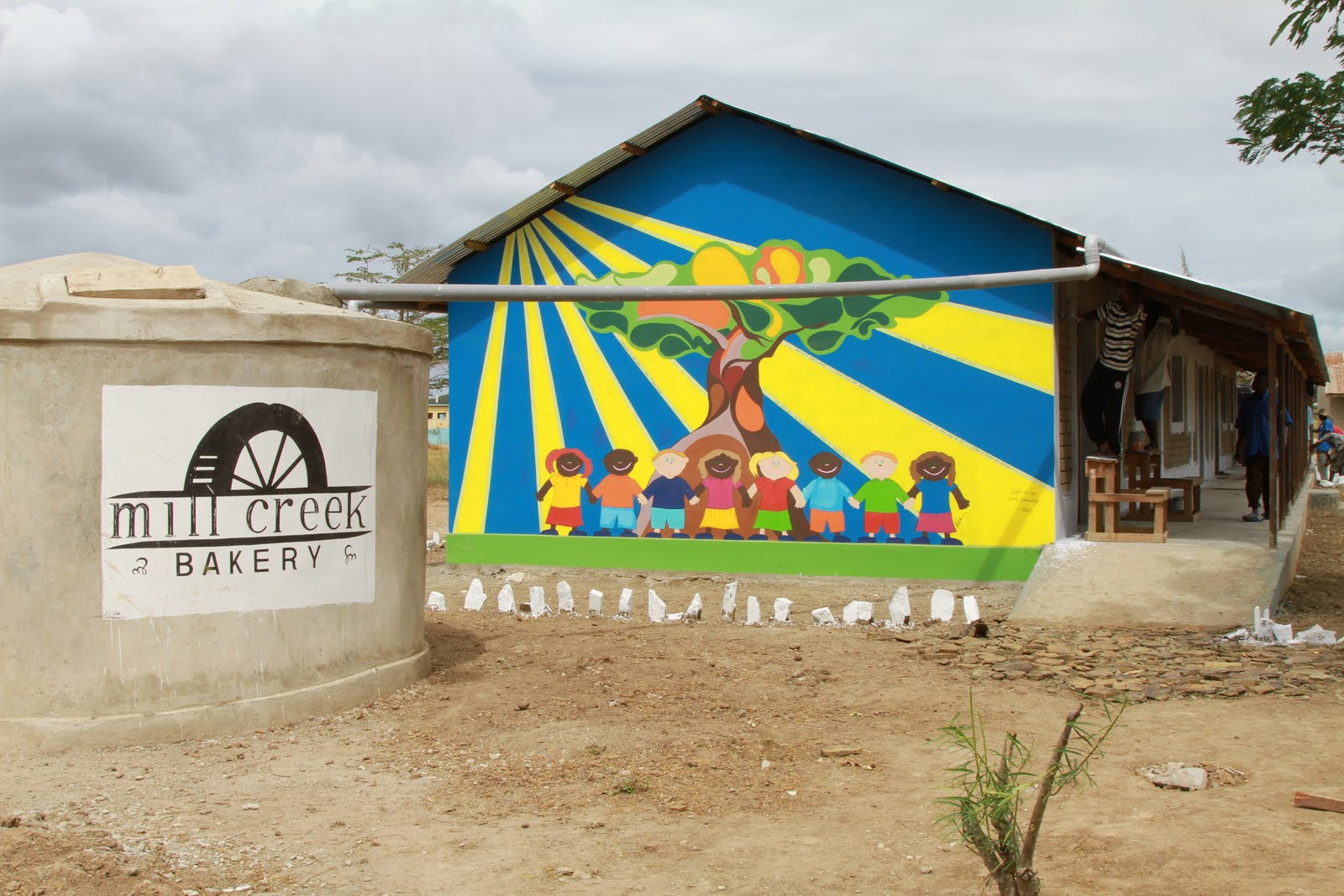 |
| Examples of cisterns at Koins built school |
 |
| Cisterns provide water so children don't need to bring water to school |
One day we are driving to Miyani to teach our lessons in the school. I notice a trail of yellow in the distance. As we get closer I notice the trail of yellow is water containers, all lined up in a row. “What is happening there?” I ask. It is explained that there is a water tap/faucet and the women bring their water containers and line them up, waiting their turn to get water. The faucet is only turned on at certain times so they leave their empty containers in a line. Later in the morning I notice the women have come back to wait with their containers. I go over to talk to them and take some photos, they don’t speak English so I can only watch. The faucet is turned on and each one fills up her container as the water slowly flows out, when it is full she lifts it on her head and walks home. Wow, another fascinating moment, they are lining up and waiting for water!! In America we get frustrated if there is no ice in our drink, these women are waiting for water!!!
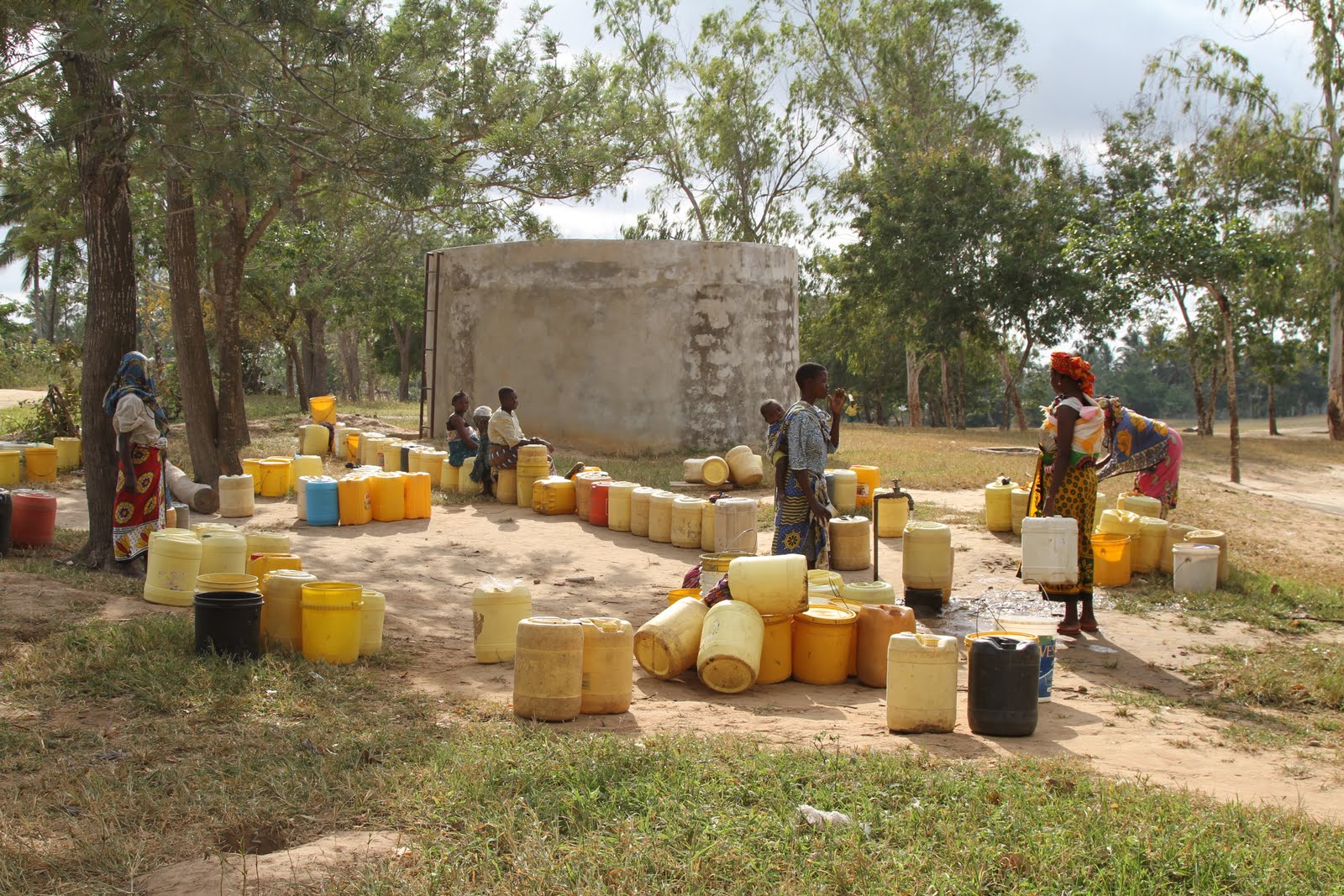 |
| Women wait at water tap in Miyani to fill their buckets |

On Sunday we go to church in Mombasa. Afterwards we eat at a restaurant before going back to the village. We are accompanied by a darling 19 year old girl named Leah. I have the good fortune of sitting next to her and getting to know her. After a while I am chatting with my fellow expeditioners about our lives back home. We start talking about the many thefts in our neighborhoods, houses broken into, bikes and snowboards stolen out of our garages, etc. Leah tells me she went to a secondary boarding school that was in a particularly dry area. Each student, male and female, was responsible for getting his or her own water. This meant they had to walk to get water every morning and evening. The water was scarce and added manual labor to an already busy day of studying and learning. Fellow students stole your water while you were in class. This became such a problem that they built locked boxes for your water bucket. Each day you locked your water in a box so other students wouldn’t be able to steal it. OH MY!!! We are complaining about stolen sports equipment and she tells us about stolen water!
 |
| Candace and Leah |
One afternoon I am able to shadow a woman in the village named Betty. She speaks excellent English so I am able to communicate with her and ask her many questions about her daily life. She washes the tin pots, rinses her hands, cooks, does laundry, and drinks with the same water. She teaches me to smash and grind the corn. Betty and her daughter-in-law pick up every kernel that falls in the dirt and place it back in the bowl. We make ugali (thick corn meal mush) for the children that stand outside her home. We pick corn and vegetables in her shamba.
She tells me we are going to get water. Previous experience tells me I can’t carry 5 gallons so I opt for a smaller container. We walk 20 minutes with our empty containers. We get to the watering hole and it has a locked gate. She unrolls her kanga cloth, the one she will wear on her head to create a somewhat flat surface, sets it on the ground, sits down, pats the ground next to her and says, “sit down, we wait”. “How long do you usually wait?” I ask. “Don’t know, sometimes 10 minutes, sometimes 3 hours,” she responds.
 |
| Candace grinds corn |
 |
| Candace makes ugali |
 |
| Betty and her daughter pound the corn |
She tells me we are going to get water. Previous experience tells me I can’t carry 5 gallons so I opt for a smaller container. We walk 20 minutes with our empty containers. We get to the watering hole and it has a locked gate. She unrolls her kanga cloth, the one she will wear on her head to create a somewhat flat surface, sets it on the ground, sits down, pats the ground next to her and says, “sit down, we wait”. “How long do you usually wait?” I ask. “Don’t know, sometimes 10 minutes, sometimes 3 hours,” she responds.
 |
| Waiting for the water hole gate to be unlocked |
 |
| Locked gate in front of watering hole |
As we wait women and children begin to stream into the area, all with empty water containers, waiting for water. I count 70-75 people, all gathered around, chatting, children playing, everyone waiting. It is a surreal moment, Kenyan women and children, and me, just me, waiting for water. We wait 45 minutes until someone comes to open the gate. We fill our containers, once again, everyone is watching me as I make an attempt to carry the water on my head. I can hold it there for a short time, but still can’t balance, I opt to carry it as I have chosen 2 containers with handles. As we are walking back to Betty’s house, a few English speakers yell out as they pass by, “carry it on your head”. If I only could!
 |
| Koins group visits the classrooms at Boyani |
Another day we are told to get in the vans, we are going to a school that is further away, we won’t be teaching, we are just going there. We do as we are told, pile into the vans, drive on more dusty bumpy roads to Boyani. Young children are playing in the yard, some of them cry and run away when they see white people. The teachers are thrilled to see us.
 |
| A class is held under a tree, as there is no room available |
 |
| Local women gather for a meeting with visitors from America |
Word travels fast that a group of Americans are staying at the KCC. A meeting is set up for the women of the local villages and everyone wants to be involved. Women and children gather in the church next to the KCC. Ingrid wants me to count how many are in attendance. At one point I count 67 women and 75 children. More women stream through the doors, most with a baby on her back and many with toddlers. They all shift places on the benches and I lose track of the numbers.
They are beautiful, so beautiful, black skin with dark eyes, broad noses, thick lips, most with short cropped hair, some with tight rows of braids, many with brightly colored scarves or cloths wrapped around their heads, shirts of varying types and colors, women wearing brightly colored kanga cloth skirts, some with flip flops, most with bare feet, all with dirty feet. Babies tied to the back with a cloth are shifted to the front for convenient nursing. I live in the moment, I cherish this experience. I love it here, I love these people. I love every moment of teaching and serving the people of rural Kenya. I notice no one carries water or a snack. Many speak a little bit of English but most don’t speak any English.
Our interpreter, Naomi, interprets what Cindy has to say. Naomi is dressed in pants which is very unusual for this area. She carries her baby on her hip in a more western way. Cindy begins the meeting and welcomes the women with appreciation and love. “What is your number one, first and foremost problem that you would like to discuss?” asks Cindy through our interpreter. She restates the question by adding, “what is your biggest problem, how can we make your lives easier?” “Water, we need more water,” they state in unison. “We need more wells, we need more cisterns, we need ways to get more water.” Water, the answer is water. Water is their number one concern! A lengthy discussion takes place about water and water rights. Watching and listening to these women confirms my belief in the strength of women worldwide.
We end the meeting and they ask us to sing and dance. Ingrid, Cindy, Sarah, and I have to quickly come up with something that we all know to entertain them. In an ironic twist we sing the primary song “Give Said the Little Stream”. “Give said the little stream as it hurried down the hill”, we sing, we make up exaggerated actions for the song as we go along. The meeting is over, I leave and go to the KCC next door and get a drink of water.
 |
| Candace at women's meeting |
They are beautiful, so beautiful, black skin with dark eyes, broad noses, thick lips, most with short cropped hair, some with tight rows of braids, many with brightly colored scarves or cloths wrapped around their heads, shirts of varying types and colors, women wearing brightly colored kanga cloth skirts, some with flip flops, most with bare feet, all with dirty feet. Babies tied to the back with a cloth are shifted to the front for convenient nursing. I live in the moment, I cherish this experience. I love it here, I love these people. I love every moment of teaching and serving the people of rural Kenya. I notice no one carries water or a snack. Many speak a little bit of English but most don’t speak any English.
 |
| Naomi conducts women's meeting |
Our interpreter, Naomi, interprets what Cindy has to say. Naomi is dressed in pants which is very unusual for this area. She carries her baby on her hip in a more western way. Cindy begins the meeting and welcomes the women with appreciation and love. “What is your number one, first and foremost problem that you would like to discuss?” asks Cindy through our interpreter. She restates the question by adding, “what is your biggest problem, how can we make your lives easier?” “Water, we need more water,” they state in unison. “We need more wells, we need more cisterns, we need ways to get more water.” Water, the answer is water. Water is their number one concern! A lengthy discussion takes place about water and water rights. Watching and listening to these women confirms my belief in the strength of women worldwide.
 |
| Young mother and baby at women's meeting |
We end the meeting and they ask us to sing and dance. Ingrid, Cindy, Sarah, and I have to quickly come up with something that we all know to entertain them. In an ironic twist we sing the primary song “Give Said the Little Stream”. “Give said the little stream as it hurried down the hill”, we sing, we make up exaggerated actions for the song as we go along. The meeting is over, I leave and go to the KCC next door and get a drink of water.

Through a donation from LDS Humanitarian, there are three borehole wells in the Koins service area. Ultimately, we hope to have more of these kinds of wells available to the villagers, to provide fresh, clean water, at an accessible distance.
Water is available to the villagers of the Koins service area from these sources:
- Above ground watering holes and rivers, subject to seasonal drought, disease, filth. Also used by animals as their water source.
- Water cisterns. Unavailable to the average rural Kenyan due to cost and the need for a tin roof and gutter to capture water. Koins for Kenya builds cisterns alongside the schools we build, to capture rainwater and eliminate the need for children to bring water to school.
- Water taps. The Kenyan government has provided water taps, such as the one Candace described on the outskirts of the Miyani school. They are sparsely located, and the water does not always run. They are subject to broken pipes and spigots. When they work, they are a precious source of water to villagers.
- Bore hole wells. These are costly, and need upkeep, but provide a clean, unlimited source of fresh water. Currently limited to three wells in the Koins service area.
- An occasional water truck, sent by a humanitarian organization, will drive through more remote villages to deliver water. Women will come running with their buckets to fill, eeking one more days worth of this life giving substance.
Koins for Kenya is looking into a cheaper way to bore wells. There is technology available that doesn't cost as much as a traditional machine drilled bore hole. Using this new technology, it might be possible to provide a well for as little as $3,000 each. We will be looking for sponsors to help us purchase the initial equipment. at a cost of $4,000 - $5,000, and provide the $3,000 wells in various villages. It would be ideal to provide a well within reasonable walking distance of each village we serve. Truly, water is life in Kenya.
Asante sana,
IVL
Subscribe to:
Posts (Atom)